
Geography / 10-question mixed rounds
Spanish-speaking countries and capitals quiz
Match capitals and places across the Spanish-speaking world.
Mixed rounds: about 3–5 minutes · No timer
10 random questions per mixed round · 50 questions in the full bank below
Published by Quizpen · Explanations include linked supporting reading. See our source-checking process and review limits.
PRACTICE BY SKILL
Choose a focused round
Practice one part of this topic with every question in that skill. Focused practice is separate from ten-question mixed rounds.
Getting your round ready…
BEHIND THE ROUND
A little more about this quiz
This bank uses the conventional classroom set of twenty Spanish-speaking sovereign countries across the Americas, Europe, and Africa. Puerto Rico appears separately as a US territory. Alongside capital pairs, questions explore neighbors, coastlines, shared islands, and the multilingual character of countries such as Paraguay.
Capital names need precise wording. Bolivia’s constitutional capital is Sucre, while La Paz is its seat of government; Honduras’s constitution names Tegucigalpa and Comayagüela jointly. The Equatorial Guinea questions explicitly date the January 2026 declaration of Ciudad de la Paz as capital. Mixed rounds draw ten of fifty questions. Focused practice separates the twenty sovereign-country capital pairs, capital context, and regional geography; each answer includes an explanation.
RECALL LAB
Type capitals, then recall the countries
Practice all twenty sovereign-country pairs in either direction. Accents and documented English/Spanish city names are accepted; read the precise role in each prompt.
This is a conventional classroom set. Puerto Rico is a US territory and is outside the twenty-country round. Bolivia asks for Sucre; Honduras asks for both jointly designated cities; Equatorial Guinea follows the January 2026 declaration.
Untimed practice. Each target appears once. Check an answer before moving on, then revisit missed items. Results stay in this activity for this visit; your saved quiz round remains available above.
Study the complete target set and sources
| Target | Capital |
|---|---|
| Argentina | Buenos Aires |
| Bolivia | Sucre |
| Chile | Santiago |
| Colombia | Bogotá |
| Costa Rica | San José |
| Cuba | Havana |
| Dominican Republic | Santo Domingo |
| Ecuador | Quito |
| El Salvador | San Salvador |
| Equatorial Guinea | Ciudad de la Paz |
| Guatemala | Guatemala City |
| Honduras | Tegucigalpa and Comayagüela |
| Mexico | Mexico City |
| Nicaragua | Managua |
| Panama | Panama City |
| Paraguay | Asunción |
| Peru | Lima |
| Spain | Madrid |
| Uruguay | Montevideo |
| Venezuela | Caracas |
LEARN THE PATTERN
Learn Spanish-speaking countries and capitals in regional groups
Work through the twenty sovereign-country pairs first. A second practice group covers capital roles, Puerto Rico’s territory status, and dated naming changes.
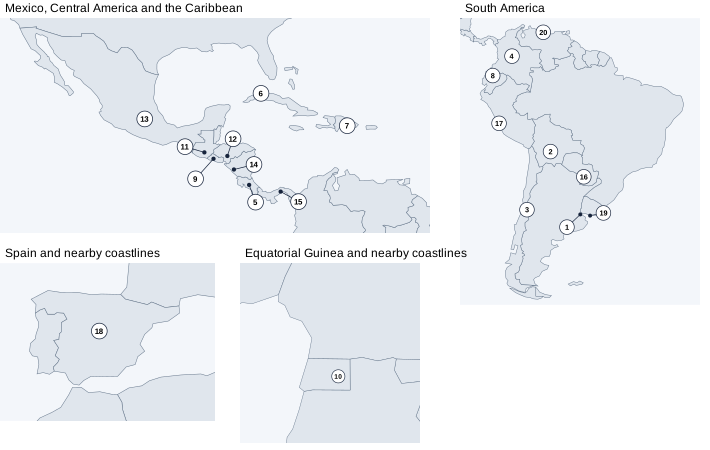
Spanish-speaking countries and capitals by study region
Review the twenty sovereign-country pairs in regional groups, then add Puerto Rico separately as a US territory. The notes preserve capital roles and the dated Equatorial Guinea change.
| Country or territory | Capital | Study region | Scope or naming note |
|---|---|---|---|
| Argentina | Buenos Aires | South America | Sovereign country |
| Bolivia | Sucre | South America | Constitutional capital; La Paz is the seat of government |
| Chile | Santiago | South America | Sovereign country |
| Colombia | Bogotá | South America | Sovereign country |
| Costa Rica | San José | Central America | Sovereign country |
| Cuba | Havana | Caribbean | Sovereign country |
| Dominican Republic | Santo Domingo | Caribbean | Sovereign country |
| Ecuador | Quito | South America | Sovereign country |
| El Salvador | San Salvador | Central America | Sovereign country |
| Equatorial Guinea | Ciudad de la Paz | Africa | Declared capital on January 2, 2026; formerly Malabo |
| Guatemala | Guatemala City | Central America | Sovereign country |
| Honduras | Tegucigalpa and Comayagüela | Central America | Joint constitutional designation; short lists often say Tegucigalpa |
| Mexico | Mexico City | Mainland North America | Sovereign country |
| Nicaragua | Managua | Central America | Sovereign country |
| Panama | Panama City | Central America | Sovereign country |
| Paraguay | Asunción | South America | Sovereign country |
| Peru | Lima | South America | Sovereign country |
| Spain | Madrid | Europe | Sovereign country |
| Uruguay | Montevideo | South America | Sovereign country |
| Venezuela | Caracas | South America | Sovereign country |
| Puerto Rico | San Juan | Caribbean | US territory; outside the twenty sovereign-country total |
The twenty-country total excludes Puerto Rico because it is a territory. Belize and Brazil are outside this conventional set; that does not mean nobody speaks Spanish there. Honduras’s Article 8 names Tegucigalpa and Comayagüela jointly.
Reference sources: Instituto Cervantes: the conventional Spanish-speaking country set · OAS: country and capital directory · OAS: Bolivia, constitutional capital and seat of government · Honduras constitution: joint capital designation in Article 8 · Equatorial Guinea government: capital declaration, January 2, 2026 · Spanish constitution: Madrid as capital
Check what you remember
Look away from the table. Try each question, then open it to check your answer.
Which two sovereign countries in this set are outside the Americas?Show answer
Spain, in Europe, and Equatorial Guinea, in Africa.
What is Bolivia’s constitutional capital, and which city is its seat of government?Show answer
Sucre is the constitutional capital. La Paz is the seat of government. Read which role a question asks for.
Why might an older capital list disagree about Equatorial Guinea?Show answer
The government declared Ciudad de la Paz the capital on January 2, 2026. Malabo was the earlier capital; this quiz dates the change explicitly.
Build a complete twenty-country list
The classroom set has nine countries in South America, six in Central America, Mexico, Cuba, the Dominican Republic, Spain, and Equatorial Guinea. Puerto Rico adds San Juan as a territory-capital pair; it is outside the twenty sovereign-country total. This scope does not imply that Spanish-speaking communities exist only in these places.
Recall the pair in both directions
Name the capital from the country, then cover the country column and reverse the exercise. Give Guatemala City and Panama City their full names. Keep San José in Costa Rica separate from San Salvador in El Salvador, and compare Santiago in Chile with Santo Domingo in the Dominican Republic.
Check a capital’s precise role and date
Sucre is Bolivia’s constitutional capital; La Paz is the seat of government. Honduras’s constitution names Tegucigalpa and Comayagüela jointly, although many short lists use Tegucigalpa. Equatorial Guinea declared Ciudad de la Paz its capital on January 2, 2026; Malabo is the earlier designation. Read the question’s wording before treating a shortened or older list as equivalent.
Connect the names with a map
Use the country-and-region practice to attach each capital pair to coasts, borders, and neighboring places. After a round, build a worksheet from the pairs you missed rather than repeatedly reading the whole table. For a group activity, ask one player for the country from a capital and the next player for its study region.
Put it into practice
- Try a ten-question mixed round
- Try typed recall, maps and printable practice
- Practice all twenty country-capital pairs
- Review capital roles and territory status
- Connect countries, regions, and neighbors
- Build a countries-and-capitals worksheet
- Locate South American countries on maps
- Locate Central American and Caribbean countries
Further reading: Instituto Cervantes: the conventional Spanish-speaking country set · OAS: country and capital directory · OAS: Bolivia, constitutional capital and seat of government · Honduras constitution: joint capital designation in Article 8 · Equatorial Guinea government: capital declaration, January 2, 2026 · Spanish constitution: Madrid as capital
QUESTIONS & ANSWERS
Spanish-speaking countries and capitals quiz: the full question sheet
Match capitals and locations across 20 Spanish-speaking sovereign countries, with Puerto Rico clearly labeled as a territory. Play ten random questions from 50.
By Quizpen · Updated
Browse the full question bank50 questions & answers
What is the capital of Argentina?
Reveal answer
Buenos Aires. Buenos Aires stands beside the Río de la Plata estuary. Its federal capital role is distinct from the surrounding province that shares its name.
Sources for this answer
What is Bolivia’s constitutional capital?
Reveal answer
Sucre. Article 6 of Bolivia’s constitution names Sucre as capital. La Paz is the seat of government.
Sources for this answer
What is the capital of Chile?
Reveal answer
Santiago. Santiago is an inland city in central Chile near the Andes. Valparaíso, another answer choice, is a separate Pacific port city.
Sources for this answer
What is the capital of Colombia?
Reveal answer
Bogotá. Bogotá lies in the Andes, inland from Colombia’s two ocean coastlines. Medellín, Cali, and Cartagena are other Colombian cities.
Sources for this answer
What is the capital of Costa Rica?
Reveal answer
San José. San José is inland in Costa Rica’s Central Valley. San Salvador and Managua are the capitals of different Central American countries.
Sources for this answer
What is the capital of Cuba?
Reveal answer
Havana. Havana lies on Cuba’s northwestern coast. Santiago de Cuba is a separate city near the eastern end of the island.
Sources for this answer
What is the capital of Dominican Republic?
Reveal answer
Santo Domingo. Santo Domingo is on the Dominican Republic’s southern coast. It is not the capital of neighboring Haiti, which shares Hispaniola.
Sources for this answer
What is the capital of Ecuador?
Reveal answer
Quito. Quito is an Andean capital near the equator. Guayaquil is a major coastal city, so the two serve as useful geographic contrasts.
Sources for this answer
What is the capital of El Salvador?
Reveal answer
San Salvador. San Salvador is the capital of El Salvador. San José, Tegucigalpa, and Guatemala City belong to three neighboring countries in the broader region.
Sources for this answer
Which city did Equatorial Guinea declare its capital on 2 January 2026?
Reveal answer
Ciudad de la Paz. The government declared Ciudad de la Paz the capital on 2 January 2026. Malabo is the former capital; the change makes older study lists outdated.
Sources for this answer
What is the capital of Guatemala?
Reveal answer
Guatemala City. Guatemala City is the national capital. Antigua Guatemala is a different city, despite its related name.
Sources for this answer
Which city is commonly listed as the capital of Honduras?
Reveal answer
Tegucigalpa. Many short capital lists use Tegucigalpa. Article 8 of Honduras’s constitution names Tegucigalpa and Comayagüela jointly as the national capital. Together they form the Central District.
Sources for this answer
What is the capital of Mexico?
Reveal answer
Mexico City. Mexico City is an inland capital. Guadalajara, Monterrey, and Puebla are other Mexican cities; Mexico City’s federal role distinguishes it.
Sources for this answer
What is the capital of Nicaragua?
Reveal answer
Managua. Managua lies beside Lake Managua. Nicaragua also contains the larger Lake Nicaragua, the lake associated with Ometepe.
Sources for this answer
What is the capital of Panama?
Reveal answer
Panama City. Panama City is on the Pacific side of Panama. Colón, another answer choice, is on the canal’s Caribbean side.
Sources for this answer
What is the capital of Paraguay?
Reveal answer
Asunción. Asunción stands on the Paraguay River. The country is landlocked, so a riverfront location should not be mistaken for an ocean coast.
Sources for this answer
What is the capital of Peru?
Reveal answer
Lima. Lima is in Peru’s Pacific coastal region. Cusco is a separate Andean city associated with Inca history.
Sources for this answer
What is the capital of Spain?
Reveal answer
Madrid. Article 5 of Spain’s constitution names Madrid as the capital. Its inland location contrasts with coastal Barcelona and Valencia.
Sources for this answer
What is the capital of Uruguay?
Reveal answer
Montevideo. Montevideo stands on the Río de la Plata’s northern side. Buenos Aires lies across the estuary region in Argentina.
Sources for this answer
What is the capital of Venezuela?
Reveal answer
Caracas. Caracas lies in Venezuela’s northern coastal mountains. It is inland from the Caribbean Sea rather than directly on an ocean beach.
Sources for this answer
Which Bolivian city is the seat of government?
Reveal answer
La Paz. La Paz is the seat of Bolivia’s executive and legislature. Sucre remains the constitutional capital.
Sources for this answer
What is the capital of the US territory of Puerto Rico?
Reveal answer
San Juan. San Juan is Puerto Rico’s capital. Puerto Rico is included here as a territory, not as a twenty-first sovereign country.
Sources for this answer
Which description correctly states Puerto Rico’s political status?
Reveal answer
A territory of the United States. Puerto Rico is a US territory. Its extensive use of Spanish does not make it a separate sovereign state.
Sources for this answer
Which city was Equatorial Guinea’s capital before the January 2026 change?
Reveal answer
Malabo. Malabo is on Bioko island. The January 2026 declaration moved the capital designation to Ciudad de la Paz in the mainland region.
Sources for this answer
Ciudad de la Paz is in which part of Equatorial Guinea?
Reveal answer
The mainland region. Ciudad de la Paz is in the mainland region, unlike former capital Malabo on Bioko island.
Sources for this answer
Which of this quiz’s Spanish-speaking sovereign countries is in Europe?
Reveal answer
Spain. Spain is in Europe, Equatorial Guinea is in Africa, and the remaining eighteen sovereign countries in this conventional classroom set are in the Americas.
Sources for this answer
Which of this quiz’s twenty sovereign countries is in Africa?
Reveal answer
Equatorial Guinea. Equatorial Guinea is the African country in this Spanish-speaking set. Guinea and Guinea-Bissau are different countries.
Sources for this answer
Which language shares official status with Spanish in Paraguay?
Reveal answer
Guaraní. Paraguay’s constitution recognizes both Spanish and Guaraní as official languages.
Sources for this answer
Which Spanish-speaking country shares Hispaniola with Haiti?
Reveal answer
Dominican Republic. The Dominican Republic occupies eastern Hispaniola; Haiti occupies the western part.
Sources for this answer
Which Spanish-speaking sovereign country occupies the long island south of Florida?
Reveal answer
Cuba. Cuba lies south of Florida and north of Jamaica. It is distinct from nearby Hispaniola.
Which Spanish-speaking country shares Mexico’s southern land border?
Reveal answer
Guatemala. Guatemala borders southern Mexico. Belize also borders Mexico but is outside the twenty-country Spanish-speaking set defined for this quiz.
Sources for this answer
Among the seven countries of the Guatemala-to-Panama isthmus, which is outside this quiz’s Spanish-speaking sovereign-country set?
Reveal answer
Belize. Belize has English as its official language. The other six countries of this isthmus are in the Spanish-speaking set used here.
Sources for this answer
Which two Spanish-speaking South American countries are landlocked?
Reveal answer
Bolivia and Paraguay. Bolivia and Paraguay have no coastline; both appear in this Spanish-speaking country set.
Sources for this answer
Which Spanish-speaking country shares the long southern land border of the contiguous United States?
Reveal answer
Mexico. Mexico borders the contiguous United States from the Pacific side to the Gulf of Mexico.
Sources for this answer
Which country borders mainland Spain along much of its western side?
Reveal answer
Portugal. Portugal occupies the western side of the Iberian Peninsula, alongside Spain.
Sources for this answer
Which pair of Spanish-speaking countries shares a long border along the Andes in southern South America?
Reveal answer
Chile and Argentina. Chile and Argentina lie on opposite sides of much of the southern Andes.
Sources for this answer
Which two Spanish-speaking countries share Lake Titicaca?
Reveal answer
Peru and Bolivia. Lake Titicaca straddles the Peru–Bolivia border in the Andes.
Sources for this answer
The Galápagos Islands are part of which Spanish-speaking country?
Reveal answer
Ecuador. The Galápagos are Ecuadorian islands in the Pacific Ocean, west of the mainland.
Sources for this answer
Which Spanish-speaking South American country has both a Caribbean and a Pacific coast?
Reveal answer
Colombia. Colombia faces the Caribbean in the north and the Pacific in the west.
Sources for this answer
Which sea lies north of Venezuela and its capital region?
Reveal answer
Caribbean Sea. Venezuela is on South America’s Caribbean coast; Caracas lies inland behind the coastal mountain range.
Sources for this answer
The Panama Canal connects the Pacific with which ocean through the Caribbean Sea?
Reveal answer
Atlantic Ocean. The canal links the Pacific and Atlantic shipping routes, with its Atlantic entrance on the Caribbean side.
Sources for this answer
Which countries border Costa Rica?
Reveal answer
Nicaragua and Panama. Costa Rica lies between Nicaragua to the north and Panama to the southeast.
Sources for this answer
Which Central American country contains the island of Ometepe in a large inland lake?
Reveal answer
Nicaragua. Ometepe is an island in Lake Nicaragua, in southwestern Nicaragua.
Sources for this answer
Which three countries share land borders with Honduras?
Reveal answer
Guatemala, El Salvador, and Nicaragua. Honduras borders Guatemala to the west, El Salvador to the southwest, and Nicaragua to the southeast.
Sources for this answer
Which Spanish-speaking country of the seven-country Central American isthmus has no Caribbean coastline?
Reveal answer
El Salvador. El Salvador faces only the Pacific. Honduras, Nicaragua, and Costa Rica each reach the Caribbean.
Sources for this answer
Which two countries border Uruguay?
Reveal answer
Argentina and Brazil. Uruguay borders Argentina to the west and Brazil to the north. Brazil’s main official language is Portuguese.
Sources for this answer
Which capital lies near the equator in the Ecuadorian Andes?
Reveal answer
Quito. Quito is in Ecuador’s Andes just south of the equator, which crosses Ecuador farther north.
Sources for this answer
Which estuary lies beside Buenos Aires and Montevideo?
Reveal answer
Río de la Plata. Buenos Aires and Montevideo sit on opposite sides of the Río de la Plata region, in Argentina and Uruguay respectively.
Sources for this answer
Which of these countries is outside this quiz’s twenty-country Spanish-speaking scope because Portuguese is its official language?
Reveal answer
Brazil. Brazil is Portuguese-speaking at the national official-language level. Spanish speakers live there, but it is outside the set defined for this quiz.
Sources for this answer
Tegucigalpa and which neighboring city together form Honduras’s Central District?
Reveal answer
Comayagüela. Article 8 of Honduras’s constitution names Tegucigalpa and Comayagüela jointly as the national capital. Together they form the Central District; many short capital lists use Tegucigalpa alone.
Sources for this answer
Answer key
- Buenos Aires. Buenos Aires stands beside the Río de la Plata estuary. Its federal capital role is distinct from the surrounding province that shares its name.
- Sucre. Article 6 of Bolivia’s constitution names Sucre as capital. La Paz is the seat of government.
- Santiago. Santiago is an inland city in central Chile near the Andes. Valparaíso, another answer choice, is a separate Pacific port city.
- Bogotá. Bogotá lies in the Andes, inland from Colombia’s two ocean coastlines. Medellín, Cali, and Cartagena are other Colombian cities.
- San José. San José is inland in Costa Rica’s Central Valley. San Salvador and Managua are the capitals of different Central American countries.
- Havana. Havana lies on Cuba’s northwestern coast. Santiago de Cuba is a separate city near the eastern end of the island.
- Santo Domingo. Santo Domingo is on the Dominican Republic’s southern coast. It is not the capital of neighboring Haiti, which shares Hispaniola.
- Quito. Quito is an Andean capital near the equator. Guayaquil is a major coastal city, so the two serve as useful geographic contrasts.
- San Salvador. San Salvador is the capital of El Salvador. San José, Tegucigalpa, and Guatemala City belong to three neighboring countries in the broader region.
- Ciudad de la Paz. The government declared Ciudad de la Paz the capital on 2 January 2026. Malabo is the former capital; the change makes older study lists outdated.
- Guatemala City. Guatemala City is the national capital. Antigua Guatemala is a different city, despite its related name.
- Tegucigalpa. Many short capital lists use Tegucigalpa. Article 8 of Honduras’s constitution names Tegucigalpa and Comayagüela jointly as the national capital. Together they form the Central District.
- Mexico City. Mexico City is an inland capital. Guadalajara, Monterrey, and Puebla are other Mexican cities; Mexico City’s federal role distinguishes it.
- Managua. Managua lies beside Lake Managua. Nicaragua also contains the larger Lake Nicaragua, the lake associated with Ometepe.
- Panama City. Panama City is on the Pacific side of Panama. Colón, another answer choice, is on the canal’s Caribbean side.
- Asunción. Asunción stands on the Paraguay River. The country is landlocked, so a riverfront location should not be mistaken for an ocean coast.
- Lima. Lima is in Peru’s Pacific coastal region. Cusco is a separate Andean city associated with Inca history.
- Madrid. Article 5 of Spain’s constitution names Madrid as the capital. Its inland location contrasts with coastal Barcelona and Valencia.
- Montevideo. Montevideo stands on the Río de la Plata’s northern side. Buenos Aires lies across the estuary region in Argentina.
- Caracas. Caracas lies in Venezuela’s northern coastal mountains. It is inland from the Caribbean Sea rather than directly on an ocean beach.
- La Paz. La Paz is the seat of Bolivia’s executive and legislature. Sucre remains the constitutional capital.
- San Juan. San Juan is Puerto Rico’s capital. Puerto Rico is included here as a territory, not as a twenty-first sovereign country.
- A territory of the United States. Puerto Rico is a US territory. Its extensive use of Spanish does not make it a separate sovereign state.
- Malabo. Malabo is on Bioko island. The January 2026 declaration moved the capital designation to Ciudad de la Paz in the mainland region.
- The mainland region. Ciudad de la Paz is in the mainland region, unlike former capital Malabo on Bioko island.
- Spain. Spain is in Europe, Equatorial Guinea is in Africa, and the remaining eighteen sovereign countries in this conventional classroom set are in the Americas.
- Equatorial Guinea. Equatorial Guinea is the African country in this Spanish-speaking set. Guinea and Guinea-Bissau are different countries.
- Guaraní. Paraguay’s constitution recognizes both Spanish and Guaraní as official languages.
- Dominican Republic. The Dominican Republic occupies eastern Hispaniola; Haiti occupies the western part.
- Cuba. Cuba lies south of Florida and north of Jamaica. It is distinct from nearby Hispaniola.
- Guatemala. Guatemala borders southern Mexico. Belize also borders Mexico but is outside the twenty-country Spanish-speaking set defined for this quiz.
- Belize. Belize has English as its official language. The other six countries of this isthmus are in the Spanish-speaking set used here.
- Bolivia and Paraguay. Bolivia and Paraguay have no coastline; both appear in this Spanish-speaking country set.
- Mexico. Mexico borders the contiguous United States from the Pacific side to the Gulf of Mexico.
- Portugal. Portugal occupies the western side of the Iberian Peninsula, alongside Spain.
- Chile and Argentina. Chile and Argentina lie on opposite sides of much of the southern Andes.
- Peru and Bolivia. Lake Titicaca straddles the Peru–Bolivia border in the Andes.
- Ecuador. The Galápagos are Ecuadorian islands in the Pacific Ocean, west of the mainland.
- Colombia. Colombia faces the Caribbean in the north and the Pacific in the west.
- Caribbean Sea. Venezuela is on South America’s Caribbean coast; Caracas lies inland behind the coastal mountain range.
- Atlantic Ocean. The canal links the Pacific and Atlantic shipping routes, with its Atlantic entrance on the Caribbean side.
- Nicaragua and Panama. Costa Rica lies between Nicaragua to the north and Panama to the southeast.
- Nicaragua. Ometepe is an island in Lake Nicaragua, in southwestern Nicaragua.
- Guatemala, El Salvador, and Nicaragua. Honduras borders Guatemala to the west, El Salvador to the southwest, and Nicaragua to the southeast.
- El Salvador. El Salvador faces only the Pacific. Honduras, Nicaragua, and Costa Rica each reach the Caribbean.
- Argentina and Brazil. Uruguay borders Argentina to the west and Brazil to the north. Brazil’s main official language is Portuguese.
- Quito. Quito is in Ecuador’s Andes just south of the equator, which crosses Ecuador farther north.
- Río de la Plata. Buenos Aires and Montevideo sit on opposite sides of the Río de la Plata region, in Argentina and Uruguay respectively.
- Brazil. Brazil is Portuguese-speaking at the national official-language level. Spanish speakers live there, but it is outside the set defined for this quiz.
- Comayagüela. Article 8 of Honduras’s constitution names Tegucigalpa and Comayagüela jointly as the national capital. Together they form the Central District; many short capital lists use Tegucigalpa alone.