
Entertainment / 10-question mixed rounds
Wingspan base-game power timing quiz
Follow brown-power order, pink limits and white when-played effects.
Mixed rounds: about 3–5 minutes · No timer
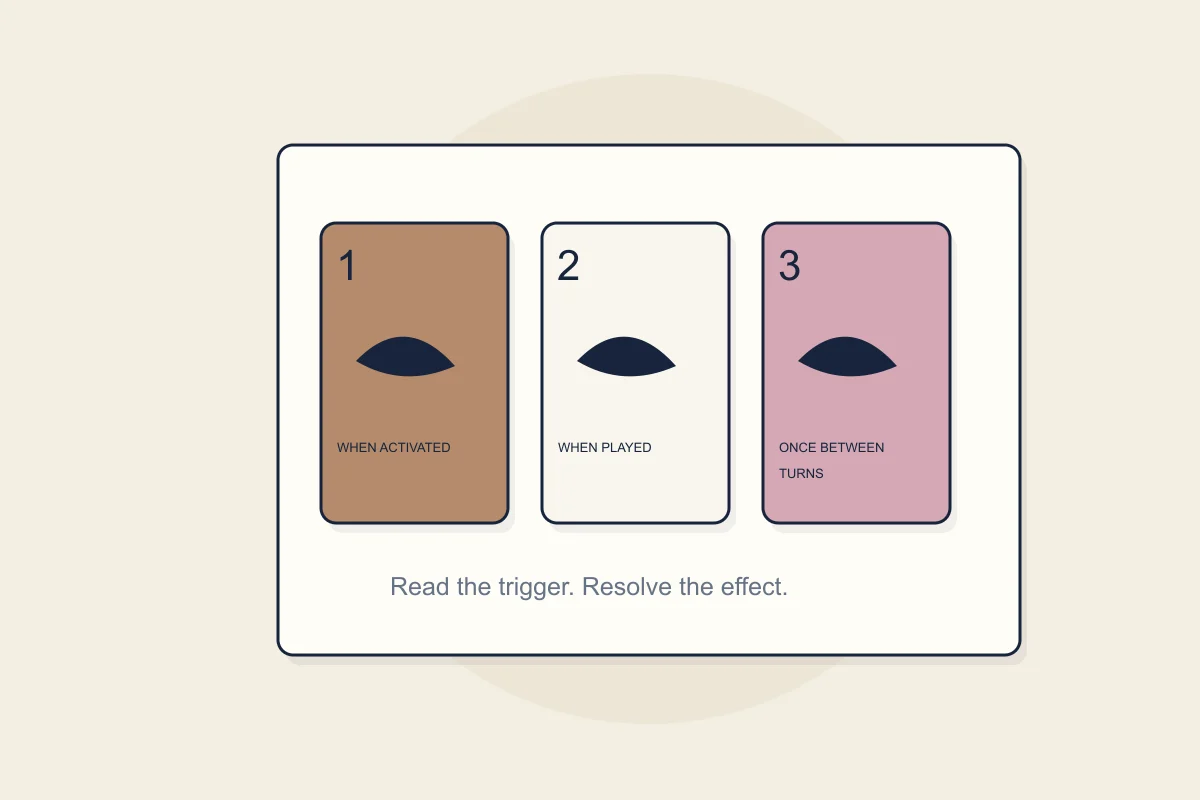
10 random questions per mixed round · 30 questions in the full bank below
Published by Quizpen · Explanations include linked supporting reading. See our source-checking process and review limits.
PRACTICE BY SKILL
Choose a focused round
Practice one part of this topic with every question in that skill. Focused practice is separate from ten-question mixed rounds.
Getting your round ready…
BEHIND THE ROUND
A little more about this quiz
A power’s timing and its condition do different jobs. Brown powers normally join a habitat activation; white or uncolored powers belong to playing a bird; pink powers watch for their condition on opponents’ turns. This page practices those original base-game categories through short invented situations.
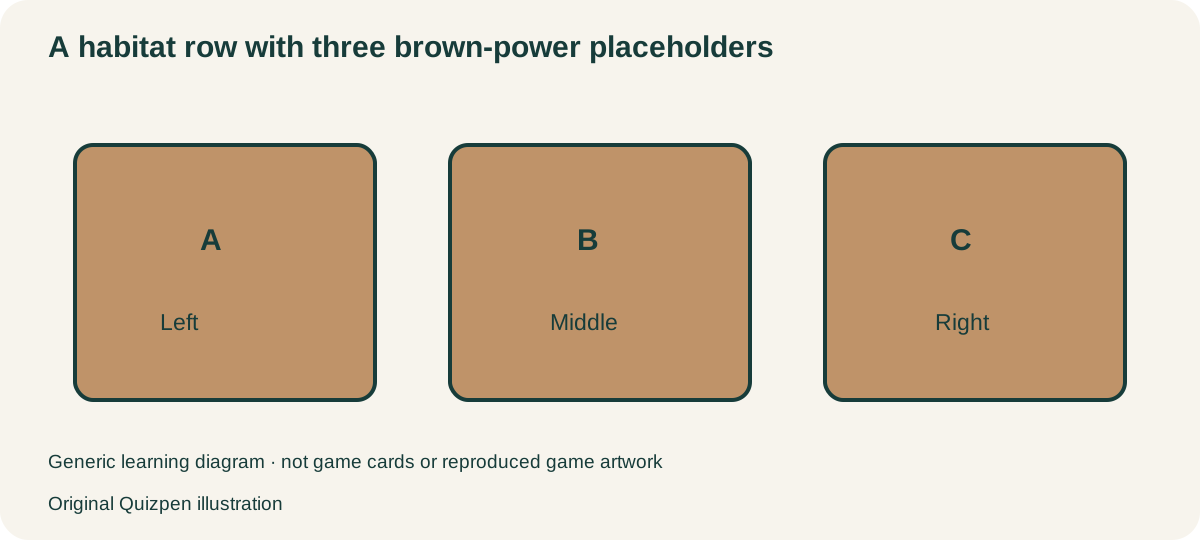
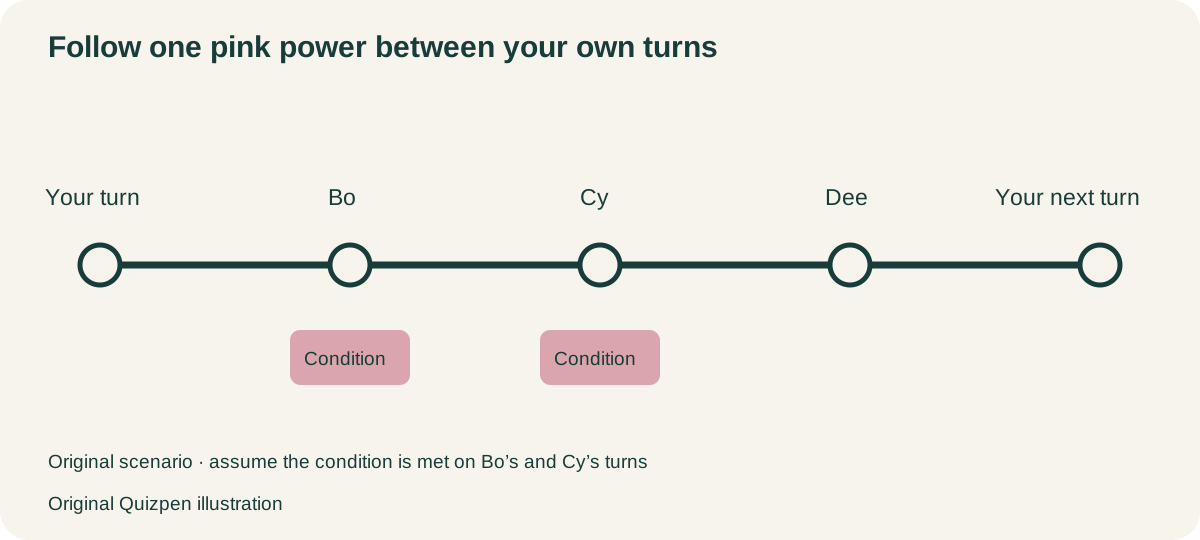
The thirty questions include ten power and habitat basics, eight pink-power limits, six when-played, repeat or migration situations, and six resource-order interactions. Original diagrams show a row of generic placeholders and a simple turn timeline. They do not reproduce bird cards or card artwork.
This bank stays with original base-game multiplayer rules. It excludes expansion colors, nectar, hummingbirds, Duet, Flock mode and Automa. Use the cited publisher rules and FAQ for the complete game; these questions target common timing confusions rather than offering a replacement rulebook.
LEARN THE PATTERN
Read the timing label before resolving the effect
Work through the selected action in order and keep each pink bird’s limit separate.
Original base-game timing reference
The color gives the timing category; the specific power still supplies its condition, cost and effect.
| Power category | Normal eligibility | Common confusion |
|---|---|---|
| Brown | During its habitat’s activation, right to left | Playing the bird is not a habitat activation. |
| White / uncolored | When that bird is played | Drawing or holding the card is not playing it. |
| Pink | On opponents’ turns, once between your own turns | One opponent after another does not reset the same bird. |
| Repeat effect | As directed, another qualifying brown power in the habitat | The original bird performs its effect. |
| Migrating bird | Only when its own conditions and destination permit | The action cube stays in the original habitat. |
This reference intentionally excludes expansion and solo rules.
Reference sources: Stonemaier Games: original Wingspan core rulebook, pages 4–10 (publisher-authored PDF mirror) · Official Wingspan Rulepop: bird-power timing · Stonemaier Games: Wingspan rules and FAQ
Check what you remember
Look away from the table. Try each question, then open it to check your answer.
In a row labeled A, B, C from left to right, what is the normal brown-power order?Show answer
C, then B, then A.
Two different pink birds have both met their conditions. Do they share one mat-wide use?Show answer
No. Each bird has its own once-between-turns limit.
Follow a habitat pass
Take the selected slot’s benefit, then visit eligible brown powers from right to left. Skipping an optional power does not stop the row. Playing a bird is a separate action, so merely placing a brown bird does not activate its habitat.
Track the interval between your turns
A pink bird needs its own stated opponent condition, and each such bird has its own once-between-turns limit. Two opponents do not create two uses of the same bird before your next turn. An unused opportunity is not stored as an extra charge.
Respect costs and special interactions
Pay a play cost before resolving the new bird’s when-played power. A repeat effect activates the chosen bird rather than moving its effect to the repeater. During migration, the action cube stays in the habitat originally selected.
- Resources gained earlier in the legal sequence can be available later in it.
- A normal row pass does not automatically go back to a skipped power.
- Keep cached food separate from personal food supply.
Put it into practice
- Try a ten-question mixed round
- Power and habitat basics
- Pink-power intervals
- When-played and special timing
- Resource timing
- Power and habitat basics: 10 questions
- Pink-power limits: 8 questions
- When-played, repeat and migration: 6 questions
- Resource order: 6 questions
- Build a worksheet with a separate answer key
Further reading: Stonemaier Games: original Wingspan core rulebook, pages 4–10 (publisher-authored PDF mirror) · Official Wingspan Rulepop: bird-power timing · Stonemaier Games: Wingspan rules and FAQ
QUESTIONS & ANSWERS
Wingspan base-game power timing quiz: the full question sheet
Practice brown, pink and white power timing with 30 original scenarios for the original Wingspan base game. Follow habitat order, between-turn limits, repeat effects and resource timing; mixed rounds draw ten.
By Quizpen · Updated
Browse the full question bank30 questions & answers
In the original Wingspan base game, which power color normally activates when you use its habitat?
Reveal answer
Brown. Brown powers belong to the corresponding habitat activation. The other timing labels have different triggers.
When does a white / uncolored power normally become eligible?
Reveal answer
When its bird is played. A white power is associated with playing that bird, not merely drawing or holding its card.
What normally makes a pink power eligible in standard multiplayer base-game play?
Reveal answer
Another player meets its stated condition between your turns. Pink powers watch opponents’ turns and still require the condition stated by the power.
All three placeholders in this row have brown powers. In which order do you normally resolve them?
 Open diagram at full size ↗
Reveal answer
C → B → A. A habitat activation proceeds from the rightmost bird toward the left.
You choose Gain Food. Which comes first: the exposed forest-slot benefit or the forest’s brown powers?
Reveal answer
The exposed-slot benefit. Take the selected habitat-slot benefit before moving through that row’s brown powers.
You play a bird with a brown power into the forest. With no other ability involved, does that play activate its brown power?
Reveal answer
No; playing it does not activate a habitat row. The Play a Bird action does not itself activate brown powers.
You play a new white-power bird beside an older white-power bird. Which white power does that normal play make eligible?
Reveal answer
The new bird’s power only. Playing a bird makes that bird’s when-played power eligible; older white powers do not restart.
You use Gain Food in the forest. Which brown powers are normally eligible in that habitat pass?
Reveal answer
Brown forest powers. The chosen habitat determines the brown-power row. Other habitats are not activated by that action.
You skip one optional brown power. What happens to the remaining eligible powers farther left?
Reveal answer
You may continue resolving them. Skipping one optional power does not cancel the rest of the row.
Sources for this answer
An optional power requires a payment you do not want to make. What may you do?
Reveal answer
Skip that power entirely. A power may be skipped, but choosing its effect does not waive a required cost.
Sources for this answer
Bo and Cy both meet the condition for the same pink power before your next turn. How many times may you use that power in this interval?
 Open diagram at full size ↗
Reveal answer
Once. The limit applies between your own turns, rather than resetting for each opponent.
Sources for this answer
During your own turn, your own pink power’s stated event occurs. Does that alone activate your pink power?
Reveal answer
No; your pink power watches opponents’ turns. In standard multiplayer play, your own turn is not an opponent’s turn.
Sources for this answer
You used a pink power, then completed another turn of your own. An opponent now meets its condition. Is it eligible again?
Reveal answer
Yes, in the new interval between your turns. Your next own turn separates the old interval from a new opportunity.
Sources for this answer
You have two different pink birds, neither used since your last turn. An opponent meets both conditions. What is the normal limit?
Reveal answer
Each bird may use its own power once. Track the once-between-turns limit separately for each pink bird.
Sources for this answer
A pink power needs an opponent’s successful predator power. The opponent only draws a card and no predator power succeeds. Is the pink power eligible?
Reveal answer
No; its stated condition was not met. The color gives a timing category; the specific condition still has to occur.
Sources for this answer
A pink bird card is still in your hand when an opponent meets its printed condition. Can you use that unplayed bird’s power?
Reveal answer
No; the bird has not been played onto your mat. Holding a card does not put its power into play.
You did not use a pink power in the previous interval. Can you save that unused opportunity to use it twice in the next interval?
Reveal answer
No; unused opportunities do not accumulate. The limit remains once between your own turns; it is not a stored resource.
Sources for this answer
Your last turn of the game is over. Before play ends, an opponent meets an otherwise unused pink power’s condition. May it activate?
Reveal answer
Yes, once after your last turn. The publisher FAQ permits a pink activation after the owner’s final turn when its condition is met.
Sources for this answer
You cannot afford a bird’s play cost, but its white power would give a useful resource. Can you use that later reward to pay the cost of playing this same bird?
Reveal answer
No; the play cost must be paid before that power. Paying and placing precede resolving the new bird’s white power.
You decline a new bird’s optional white power when playing it. Does the ordinary timing rule let you save it for a later habitat action?
Reveal answer
No; a later habitat action does not recreate its when-played timing. A declined when-played opportunity is not a stored later activation.
A brown repeat power can repeat another brown bird in the same habitat. May the chosen bird be to its left, even if its normal activation is still ahead?
Reveal answer
Yes. The publisher FAQ allows a qualifying target on either side in the same habitat.
Sources for this answer
Bird B repeats Bird A’s ability that lays an egg on Bird A itself. Where does the repeated effect place that egg, if there is capacity?
Reveal answer
On Bird A. Repeating activates the original bird’s effect; it does not transfer ownership of that effect to the repeater.
Sources for this answer
A migrating brown bird legally moves to another habitat during its activation. Where does the current action cube stay?
Reveal answer
In the original habitat row. The action cube records the action selected for that turn and remains in its original row.
Sources for this answer
A qualifying migrating bird is the only bird in its row, and its destination is legal. Does being alone prevent its migration?
Reveal answer
No; it can still satisfy the rightmost-bird condition. The publisher FAQ allows an otherwise legal migration when the bird is alone in its row.
Sources for this answer
A brown power lets you gain food from the birdfeeder. Before gaining it, all remaining dice show one identical face. Can the normal optional reroll rule apply?
Reveal answer
Yes. The normal birdfeeder reroll rule also applies when gaining food through a power.
You have one food token cached on a bird and none in your personal supply. Can you spend the cached token to pay a power that requires a personal food payment?
Reveal answer
No. Cached food stays on the bird as a scoring resource; it is separate from personal food supply.
In a legal abstract row, a right-hand brown power adds a card to your hand. A later power farther left can tuck a card from your hand. Can that newly gained card be used there?
Reveal answer
Yes, if the later power’s requirements are satisfied. Resolve effects in sequence. A card already gained is in your hand when the later power is reached.
In an ordinary habitat pass, a right-hand power needs food you lack. You skip it; a left-hand power later gains food. Can you go back to the skipped power without a repeat effect?
Reveal answer
No. The normal pass continues right to left. Later resources do not create an automatic second pass.
During Draw Cards, you take a face-up card before activating wetland brown powers. Is that empty tray space normally refilled immediately?
Reveal answer
No; normal refilling waits until the end of the turn. Normal tray refilling occurs after the turn, so do not invent an extra face-up option mid-turn.
A power would lay an egg on a bird already at its egg limit, and no stated legal placement remains. May that effect exceed the bird’s limit?
Reveal answer
No. Bird powers do not generally erase egg limits. A placement must still be legal.
Answer key
- Brown. Brown powers belong to the corresponding habitat activation. The other timing labels have different triggers.
- When its bird is played. A white power is associated with playing that bird, not merely drawing or holding its card.
- Another player meets its stated condition between your turns. Pink powers watch opponents’ turns and still require the condition stated by the power.
- C → B → A. A habitat activation proceeds from the rightmost bird toward the left.
- The exposed-slot benefit. Take the selected habitat-slot benefit before moving through that row’s brown powers.
- No; playing it does not activate a habitat row. The Play a Bird action does not itself activate brown powers.
- The new bird’s power only. Playing a bird makes that bird’s when-played power eligible; older white powers do not restart.
- Brown forest powers. The chosen habitat determines the brown-power row. Other habitats are not activated by that action.
- You may continue resolving them. Skipping one optional power does not cancel the rest of the row.
- Skip that power entirely. A power may be skipped, but choosing its effect does not waive a required cost.
- Once. The limit applies between your own turns, rather than resetting for each opponent.
- No; your pink power watches opponents’ turns. In standard multiplayer play, your own turn is not an opponent’s turn.
- Yes, in the new interval between your turns. Your next own turn separates the old interval from a new opportunity.
- Each bird may use its own power once. Track the once-between-turns limit separately for each pink bird.
- No; its stated condition was not met. The color gives a timing category; the specific condition still has to occur.
- No; the bird has not been played onto your mat. Holding a card does not put its power into play.
- No; unused opportunities do not accumulate. The limit remains once between your own turns; it is not a stored resource.
- Yes, once after your last turn. The publisher FAQ permits a pink activation after the owner’s final turn when its condition is met.
- No; the play cost must be paid before that power. Paying and placing precede resolving the new bird’s white power.
- No; a later habitat action does not recreate its when-played timing. A declined when-played opportunity is not a stored later activation.
- Yes. The publisher FAQ allows a qualifying target on either side in the same habitat.
- On Bird A. Repeating activates the original bird’s effect; it does not transfer ownership of that effect to the repeater.
- In the original habitat row. The action cube records the action selected for that turn and remains in its original row.
- No; it can still satisfy the rightmost-bird condition. The publisher FAQ allows an otherwise legal migration when the bird is alone in its row.
- Yes. The normal birdfeeder reroll rule also applies when gaining food through a power.
- No. Cached food stays on the bird as a scoring resource; it is separate from personal food supply.
- Yes, if the later power’s requirements are satisfied. Resolve effects in sequence. A card already gained is in your hand when the later power is reached.
- No. The normal pass continues right to left. Later resources do not create an automatic second pass.
- No; normal refilling waits until the end of the turn. Normal tray refilling occurs after the turn, so do not invent an extra face-up option mid-turn.
- No. Bird powers do not generally erase egg limits. A placement must still be legal.