
Entertainment / 10-question mixed rounds
US model train scale and gauge quiz
Decode US ratios and narrow-gauge labels, then calculate model dimensions.
Mixed rounds: about 3–5 minutes · No timer
10 random questions per mixed round · 30 questions in the full bank below
Published by Quizpen · Explanations include linked supporting reading. See our source-checking process and review limits.
PRACTICE BY SKILL
Choose a focused round
Practice one part of this topic with every question in that skill. Focused practice is separate from ten-question mixed rounds.
Getting your round ready…
BEHIND THE ROUND
A little more about this quiz
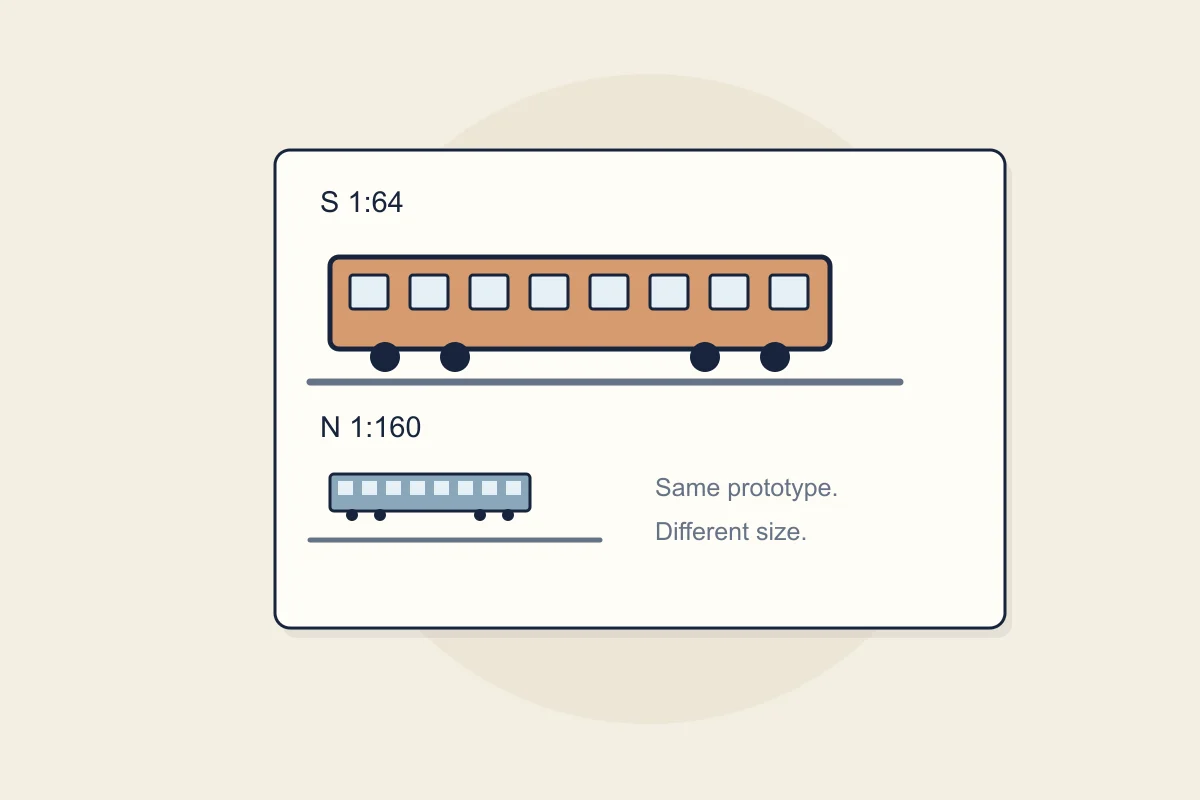
Scale answers how much a full-size object is reduced; gauge answers how far apart the rails are. This quiz keeps those measurements separate with original diagrams, US ratio questions and worked arithmetic. It uses O, S, HO, TT, N and Z conventions from the NMRA sources below.
Thirty questions cover seven concepts, seven ratio comparisons, six narrow-gauge notation items and ten applications. Mixed rounds draw ten; focused practice can cover a complete group. HO calculations explicitly use 1:87.1, and every conversion names its units.
A shared model gauge does not prove that body scales, wheels or clearances match. Treat the illustrations as learning aids. They do not reproduce NMRA engineering tables or certify a product or layout.
LEARN THE PATTERN
Read the scale first, then the gauge
Decode the label before comparing sizes or calculating dimensions.
US scale and notation reference
Ratios here follow the stated US conventions. Distinguish the body-scale label from prototype gauge.
| Label | Body ratio or meaning | Reading cue |
|---|---|---|
| O | 1:48 | Body scale |
| S | 1:64 | Body scale |
| HO | 1:87.1 | Body scale |
| TT | 1:120 | Body scale |
| N | 1:160 | Body scale |
| Z | 1:220 | Body scale |
| HOn3 | HO body scale | Three-foot prototype gauge |
| HOn30 | HO body scale | Thirty-inch prototype gauge |
| On3 | O body scale | Three-foot prototype gauge |
| Sn3 | S body scale | Three-foot prototype gauge |
| Nn3 | N body scale | Three-foot prototype gauge |
Reference sources: NMRA: beginner scale and gauge conventions · NMRA: S-3.2 track, standard scale (June 2026)
Check what you remember
Look away from the table. Try each question, then open it to check your answer.
Keep two measurements separate
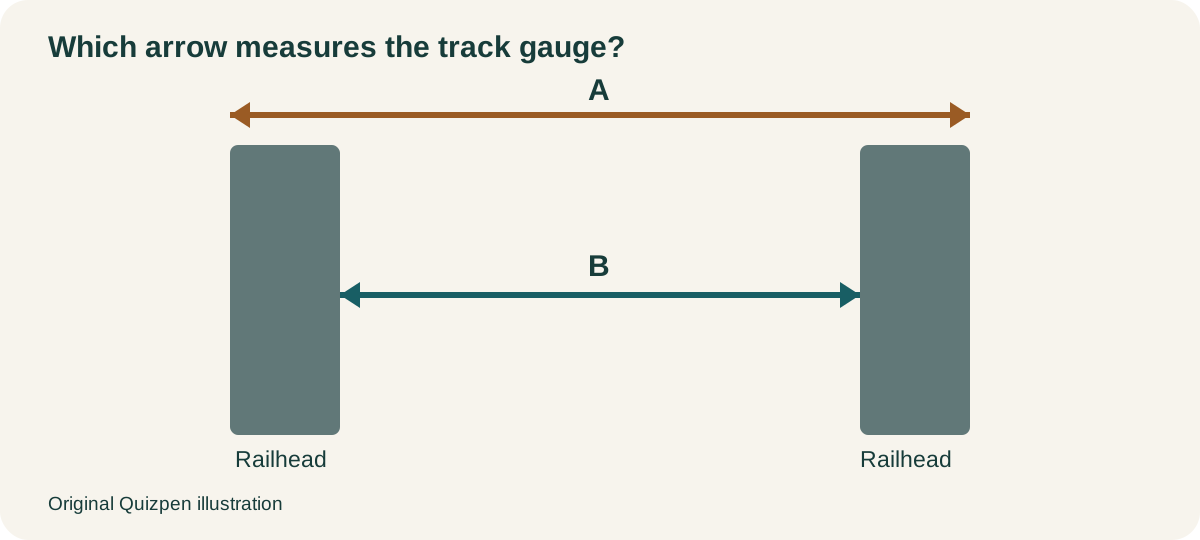
A ratio of 1:d means one model unit represents d of the same prototype units. Rail gauge measures the gap between the inside railhead edges. Models can share one measurement while differing in the other.
- Use US N = 1:160 and US O = 1:48 here.
- Large-scale track can be shared by models with different body ratios.
Read narrow-gauge notation
In HOn3, HO gives the body scale and n3 represents a three-foot prototype gauge. In HOn30 the prototype gauge is thirty inches. Changing the suffix does not turn an HO building into a different body scale.
- Keep the lowercase n suffix separate from N scale.
- Matching nominal track gauge is not a general compatibility promise.
Calculate with consistent units
For a model length, convert the prototype measurement to the desired output unit, then divide by the scale denominator. To recover the prototype length, multiply the model measurement by that denominator.
- 24 m at 1:160: 24,000 mm ÷ 160 = 150 mm.
- A 3-inch model at 1:64: 3 × 64 = 192 inches = 16 feet.
- Round only after completing the calculation.
Put it into practice
Further reading: NMRA: beginner scale and gauge conventions · NMRA: getting started in model railroading · NMRA: S-3.2 track, standard scale (June 2026)
QUESTIONS & ANSWERS
US model train scale and gauge quiz: the full question sheet
Separate body scale from rail spacing, decode narrow-gauge notation, and solve original model-size conversions. This 30-question bank uses explicit US/NMRA conventions; mixed rounds draw ten.
By Quizpen · Updated
Browse the full question bank30 questions & answers
What does scale describe in a model railroad?
Reveal answer
The model-to-prototype linear size ratio. Scale compares a model’s dimensions with its full-size prototype. Gauge concerns the distance between rails.
Sources for this answer
In this original railhead diagram, which arrow measures track gauge?
 Open diagram at full size ↗
Reveal answer
B. Track gauge is measured between the inside edges of the railheads, as arrow B shows.
Sources for this answer
A modeler measures the real bridge before building its miniature. What is the real bridge called?
Reveal answer
The prototype. In model railroading, the prototype is the full-size subject represented by the model.
Sources for this answer
What does narrow gauge describe in the prototype railway?
Reveal answer
Rails spaced more closely than standard gauge. Narrow gauge describes rail spacing. It is separate from how much the full-size subject is reduced to make a model.
Sources for this answer
Using the US/NMRA convention, what is the ratio for O scale?
Reveal answer
1:48. The US/NMRA ratio used here for O is 1:48: one model unit represents 48 prototype units.
Sources for this answer
Using the US/NMRA convention, what is the ratio for S scale?
Reveal answer
1:64. The US/NMRA ratio used here for S is 1:64: one model unit represents 64 prototype units.
Sources for this answer
Using the US/NMRA convention, what is the ratio for HO scale?
Reveal answer
1:87.1. The US/NMRA ratio used here for HO is 1:87.1: one model unit represents 87.1 prototype units.
Sources for this answer
Using the US/NMRA convention, what is the ratio for TT scale?
Reveal answer
1:120. The US/NMRA ratio used here for TT is 1:120: one model unit represents 120 prototype units.
Sources for this answer
Using the US/NMRA convention, what is the ratio for N scale?
Reveal answer
1:160. The US/NMRA ratio used here for N is 1:160: one model unit represents 160 prototype units.
Sources for this answer
Using the US/NMRA convention, what is the ratio for Z scale?
Reveal answer
1:220. The US/NMRA ratio used here for Z is 1:220: one model unit represents 220 prototype units.
Sources for this answer
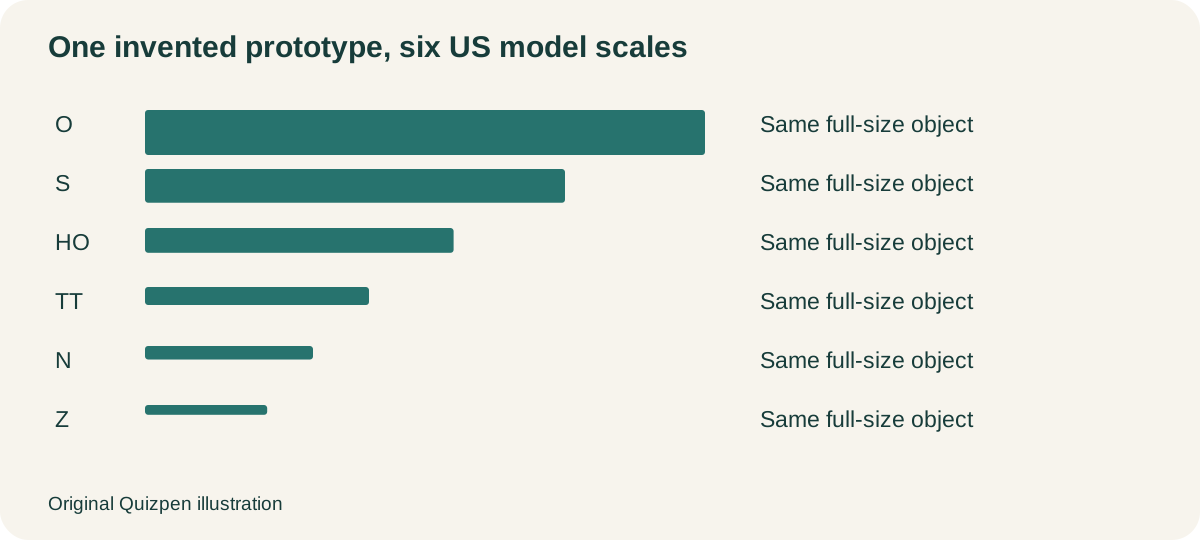
For the same full-size object, which of these six US scales produces the shortest model?
 Open diagram at full size ↗
Reveal answer
Z. With the prototype held constant, the largest denominator gives the smallest model. Z uses 1:220.
Sources for this answer
In HOn3, what prototype rail spacing does the 3 represent?
Reveal answer
3 feet. HOn3 uses HO body proportions and represents a prototype gauge of three feet.
Sources for this answer
In HOn30, what does the 30 represent?
Reveal answer
A 30-inch prototype gauge. The n30 suffix identifies thirty inches of prototype rail spacing; HO still identifies the body scale.
Sources for this answer
Which part of On3 identifies the body scale?
Reveal answer
O. On3 uses O body scale. The n3 portion identifies a three-foot narrow-gauge prototype.
Sources for this answer
How should Sn3 be read in this US notation?
Reveal answer
S body scale with a three-foot prototype gauge. S supplies the scale and n3 supplies the prototype’s three-foot gauge.
Sources for this answer
What differs between Nn3 and HOn3?
Reveal answer
The body scale; both represent three-foot prototype gauge. Nn3 uses N body proportions; HOn3 uses HO. Both suffixes describe the same three-foot prototype gauge.
Sources for this answer
On30 and standard-gauge HO can use the same nominal model track gauge. What follows?
Reveal answer
Their body scales can still differ. A shared nominal rail spacing does not make the body scales equal or guarantee equipment compatibility.
Sources for this answer
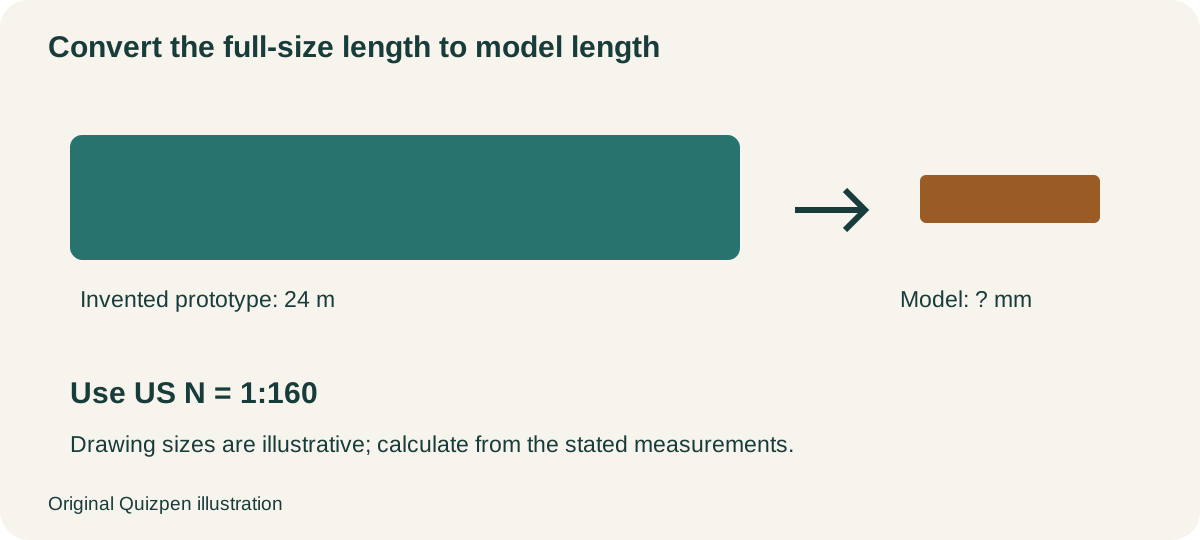
Using US N at 1:160, how long is a model of an invented 24 m prototype?
 Open diagram at full size ↗
Reveal answer
150 mm. Convert 24 m to 24,000 mm, then divide by 160: the model is 150 mm long.
Sources for this answer
At S scale, 1:64, an invented prototype is 6.4 m long. What is its model length?
Reveal answer
100 mm. 6.4 m equals 6,400 mm. Dividing by the S denominator, 64, gives 100 mm.
Sources for this answer
For this question use HO at exactly 1:87.1. What is the model length of an 8.71 m prototype?
Reveal answer
100 mm. 8.71 m is 8,710 mm. The calculation is 8,710 ÷ 87.1 = 100 mm.
Sources for this answer
At US O scale, 1:48, how long is a model of a 9.6 m prototype?
Reveal answer
200 mm. 9.6 m equals 9,600 mm. Divide by 48 to obtain a 200 mm model.
Sources for this answer
An invented 12 m prototype is modeled at TT, 1:120. What is the model length?
Reveal answer
100 mm. Convert 12 m to 12,000 mm and divide by 120. The result is 100 mm.
Sources for this answer
At Z scale, 1:220, what model length represents a 22 m prototype?
Reveal answer
100 mm. 22 m equals 22,000 mm. At 1:220, 22,000 ÷ 220 gives 100 mm.
Sources for this answer
A US N model is 25 mm long. At 1:160, how long is the prototype?
Reveal answer
4 m. Reverse the reduction: 25 mm × 160 = 4,000 mm, or 4 m.
Sources for this answer
An S-scale model is 3 inches long. At 1:64, what is the prototype length?
Reveal answer
16 feet. 3 inches × 64 = 192 inches. Divide by twelve inches per foot to get sixteen feet.
Sources for this answer
For one prototype, approximately how many times as long is its US O model as its US N model?
Reveal answer
3.33 times. The relative model length is 160 ÷ 48 = 3.333… . Rounded to two decimal places, the O model is 3.33 times as long.
Sources for this answer
Two large-scale models run on the same track gauge. What can you conclude from gauge alone?
Reveal answer
It does not establish a single body-scale ratio. Large-scale models can share rail spacing while using different body proportions. Check scale and gauge separately.
Sources for this answer
An HO layout and an HOn3 layout use models of the same building. Which statement about body proportions is correct?
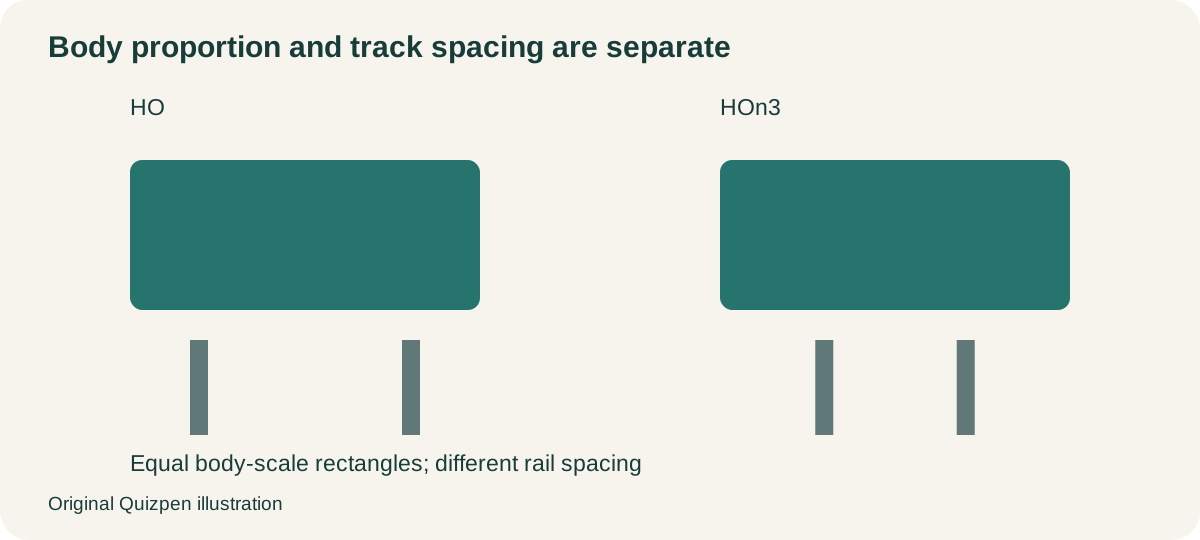 Open diagram at full size ↗
Reveal answer
Both building models use HO proportions. HO and HOn3 share body scale. The narrow-gauge suffix changes the represented rail spacing, not the building reduction.
Sources for this answer
Which full-size rail gauge is treated as standard gauge in this US introduction?
Reveal answer
4 feet 8½ inches. The standard prototype gauge used here is four feet, eight and one-half inches.
Sources for this answer
An original rectangular model block is enlarged uniformly to twice its length, width and height. What happens to its volume?
Reveal answer
It becomes eight times as large. Volume uses all three dimensions: 2 × 2 × 2 = 8. This is original geometry practice, not a claim that two named scales differ by exactly two.
Sources for this answer
Answer key
- The model-to-prototype linear size ratio. Scale compares a model’s dimensions with its full-size prototype. Gauge concerns the distance between rails.
- B. Track gauge is measured between the inside edges of the railheads, as arrow B shows.
- The prototype. In model railroading, the prototype is the full-size subject represented by the model.
- Rails spaced more closely than standard gauge. Narrow gauge describes rail spacing. It is separate from how much the full-size subject is reduced to make a model.
- 1:48. The US/NMRA ratio used here for O is 1:48: one model unit represents 48 prototype units.
- 1:64. The US/NMRA ratio used here for S is 1:64: one model unit represents 64 prototype units.
- 1:87.1. The US/NMRA ratio used here for HO is 1:87.1: one model unit represents 87.1 prototype units.
- 1:120. The US/NMRA ratio used here for TT is 1:120: one model unit represents 120 prototype units.
- 1:160. The US/NMRA ratio used here for N is 1:160: one model unit represents 160 prototype units.
- 1:220. The US/NMRA ratio used here for Z is 1:220: one model unit represents 220 prototype units.
- Z. With the prototype held constant, the largest denominator gives the smallest model. Z uses 1:220.
- 3 feet. HOn3 uses HO body proportions and represents a prototype gauge of three feet.
- A 30-inch prototype gauge. The n30 suffix identifies thirty inches of prototype rail spacing; HO still identifies the body scale.
- O. On3 uses O body scale. The n3 portion identifies a three-foot narrow-gauge prototype.
- S body scale with a three-foot prototype gauge. S supplies the scale and n3 supplies the prototype’s three-foot gauge.
- The body scale; both represent three-foot prototype gauge. Nn3 uses N body proportions; HOn3 uses HO. Both suffixes describe the same three-foot prototype gauge.
- Their body scales can still differ. A shared nominal rail spacing does not make the body scales equal or guarantee equipment compatibility.
- 150 mm. Convert 24 m to 24,000 mm, then divide by 160: the model is 150 mm long.
- 100 mm. 6.4 m equals 6,400 mm. Dividing by the S denominator, 64, gives 100 mm.
- 100 mm. 8.71 m is 8,710 mm. The calculation is 8,710 ÷ 87.1 = 100 mm.
- 200 mm. 9.6 m equals 9,600 mm. Divide by 48 to obtain a 200 mm model.
- 100 mm. Convert 12 m to 12,000 mm and divide by 120. The result is 100 mm.
- 100 mm. 22 m equals 22,000 mm. At 1:220, 22,000 ÷ 220 gives 100 mm.
- 4 m. Reverse the reduction: 25 mm × 160 = 4,000 mm, or 4 m.
- 16 feet. 3 inches × 64 = 192 inches. Divide by twelve inches per foot to get sixteen feet.
- 3.33 times. The relative model length is 160 ÷ 48 = 3.333… . Rounded to two decimal places, the O model is 3.33 times as long.
- It does not establish a single body-scale ratio. Large-scale models can share rail spacing while using different body proportions. Check scale and gauge separately.
- Both building models use HO proportions. HO and HOn3 share body scale. The narrow-gauge suffix changes the represented rail spacing, not the building reduction.
- 4 feet 8½ inches. The standard prototype gauge used here is four feet, eight and one-half inches.
- It becomes eight times as large. Volume uses all three dimensions: 2 × 2 × 2 = 8. This is original geometry practice, not a claim that two named scales differ by exactly two.