
Entertainment / 10-question mixed rounds
Traditional quilt block identification quiz
Identify traditional quilt blocks in 30 explained questions with 15 original diagrams, structural clues, naming context, focused practice and worksheets.
Mixed rounds: about 3–5 minutes · No timer
10 random questions per mixed round · 30 questions in the full bank below
Published by Quizpen · Explanations include linked supporting reading. See our source-checking process and review limits.
PRACTICE BY SKILL
Choose a focused round
Practice one part of this topic with every question in that skill. Focused practice is separate from ten-question mixed rounds.
Getting your round ready…
BEHIND THE ROUND
A little more about this quiz
Start with the repeated shapes: squares, triangles, strips, wedges or diamonds. Those features make a more reliable clue than a particular fabric color.
The chosen labels refer to these schematic versions. Museum catalogs preserve alternate names, and a block name can differ from the setting of the entire quilt.
LEARN THE PATTERN
How to practice traditional quilt block identification
Identify 15 original traditional-pattern schematics, compare ten structural clues and answer five naming-context questions. A mixed round draws ten from 30.
Traditional quilt block identification reference
Uses common names for the specific schematic versions shown. Quilt names and variants can overlap; this is structural recognition, not antique authentication, valuation or a universal naming authority.
| Selected name | Structural clue | Context |
|---|---|---|
| Simple Four Patch | Two-by-two square grid | One simple version of a broader framework |
| Simple Nine Patch | Three-by-three square grid | More complex blocks can share this framework |
| Pinwheel | Rotating triangular blades | Variants and alternate labels exist |
| Log Cabin | Strips around a central square | Light/dark placement changes a quilt’s effect |
| Courthouse Steps | Opposite pairs of strips | A Log Cabin variation in the museum source |
| Flying Geese | Wide triangles with side triangles | Units can be arranged in several ways |
| Ohio Star | Hourglass units around a center square | The specific version shown |
| Shoo Fly | Center square and corner triangle units | The specific version shown |
| Dresden Plate / Fan | Full circular ring / corner spread | Labels used for the two shown versions |
| Lone Star | Eight rays built from small diamonds | Not every eight-point star has one unique name |
Read each question’s stated scope and key before answering.
Reference sources: International Quilt Museum: fifteen named pattern clues · International Quilt Museum: how quilts get their names · Illinois State Museum: Courthouse Steps construction · Old State House Museum: Four Patch object · IQM: Nine Patch and Ohio Star object · IQM: American Quilts in the Modern Age · The Met: Pinwheel or Fly object · The Met: Flying Geese object
Check what you remember
Look away from the table. Try each question, then open it to check your answer.
Is Barn Raising a block or a setting in the museum lesson?Show answer
The setting of the Log Cabin blocks.
Does a block name establish an antique’s maker or date?Show answer
No. Object-specific provenance evidence is needed.
Read the framework before the fabric
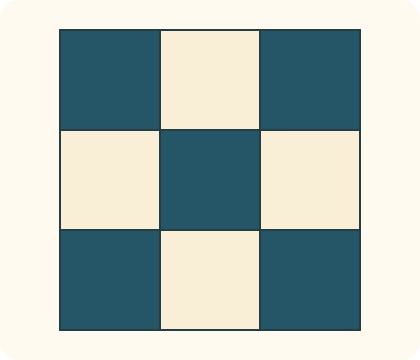
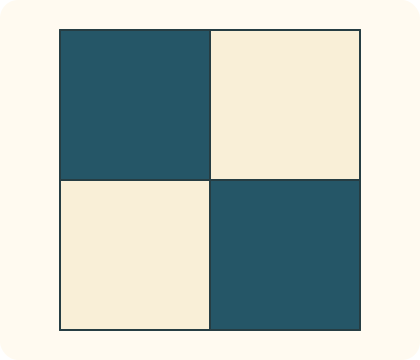
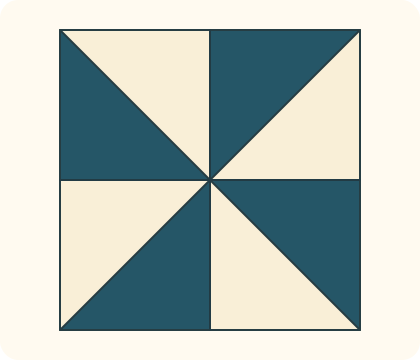
Simple Four Patch and Nine Patch examples reveal their two-by-two and three-by-three square grids. A Pinwheel turns triangle units around the center; strip blocks and wedge designs use different structures.
Compare related versions carefully
Courthouse Steps adds strips on opposite sides in pairs. The Ohio Star example has hourglass side units, while the Shoo Fly example has corner half-square triangles. Compare the displayed geometry rather than guessing from color.
Keep names tied to context
The museum’s lesson distinguishes a Log Cabin block from a Barn Raising setting. A catalog may also give alternate names. For a guild round, show the fifteen diagrams first, accept the documented labels for these versions, then discuss the naming questions separately.
Put it into practice
Further reading: International Quilt Museum: fifteen named pattern clues · International Quilt Museum: how quilts get their names · Illinois State Museum: Courthouse Steps construction · Old State House Museum: Four Patch object · IQM: Nine Patch and Ohio Star object · IQM: American Quilts in the Modern Age · The Met: Pinwheel or Fly object · The Met: Flying Geese object
QUESTIONS & ANSWERS
Traditional quilt block identification quiz: the full question sheet
Identify 15 original traditional-pattern schematics, compare ten structural clues and answer five naming-context questions. A mixed round draws ten from 30.
By Quizpen · Updated
Browse the full question bank30 questions & answers
Which common block name best fits this simple three-by-three checkerboard?
 Open diagram at full size ↗
Image source & credit
Original diagram by Quizpen Source ↗ · Quizpen original artwork. Resized for display.
Reveal answer
Nine Patch. This simple version uses nine equal square patches in three rows and three columns. More complex blocks can also use a nine-patch framework.
Sources for this answer
Which common name fits this simple two-by-two checkerboard block?
 Open diagram at full size ↗
Image source & credit
Original diagram by Quizpen Source ↗ · Quizpen original artwork. Resized for display.
Reveal answer
Four Patch. This simple version contains four square patches in two rows and two columns. The name describes its basic framework.
Sources for this answer
Which common block name fits these four triangular blades turning around the center?
 Open diagram at full size ↗
Image source & credit
Original diagram by Quizpen Source ↗ · Quizpen original artwork. Resized for display.
Reveal answer
Pinwheel. The four half-square-triangle units create a turning-blade appearance. Pinwheel variants can have additional piecing or different published names.
Sources for this answer
Which common block name fits strips that build around a small center square in this spiral-like arrangement?
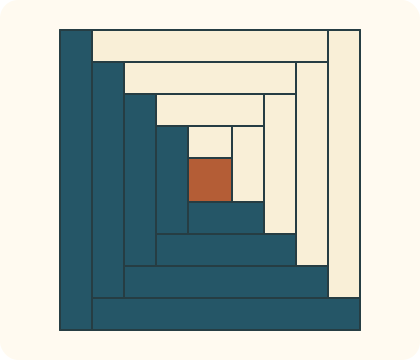 Open diagram at full size ↗
Image source & credit
Original diagram by Quizpen Source ↗ · Quizpen original artwork. Resized for display.
Reveal answer
Log Cabin. The surrounding strips suggest stacked logs. Light and dark placement can create many appearances when these blocks are arranged in a quilt.
Sources for this answer
Which Log Cabin variation adds strip pairs on opposite sides, as shown?
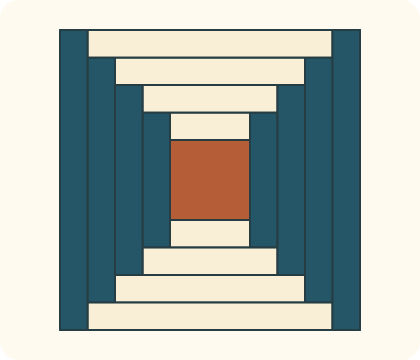 Open diagram at full size ↗
Image source & credit
Original diagram by Quizpen Source ↗ · Quizpen original artwork. Resized for display.
Reveal answer
Courthouse Steps. The Illinois State Museum explains this opposite-side construction as Courthouse Steps. It differs from working continuously around the center.
Sources for this answer
Which common name fits these wide triangular units stacked in rows?
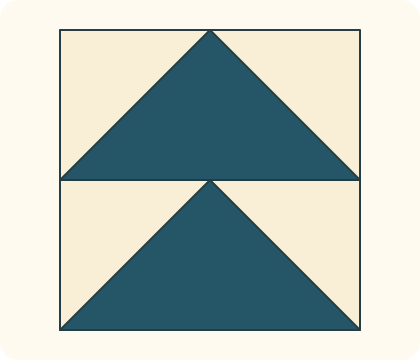 Open diagram at full size ↗
Image source & credit
Original diagram by Quizpen Source ↗ · Quizpen original artwork. Resized for display.
Reveal answer
Flying Geese. A central broad triangle and its side triangles form the recognizable unit. The museum records this traditional name; arrangements can vary.
Sources for this answer
Which common name fits this star built on a three-by-three framework with hourglass side units?
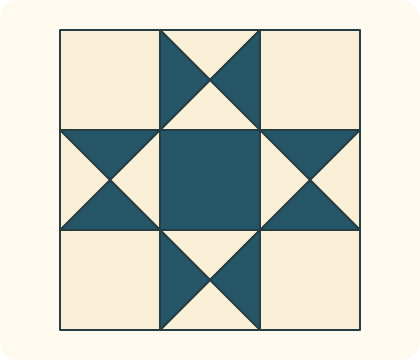 Open diagram at full size ↗
Image source & credit
Original diagram by Quizpen Source ↗ · Quizpen original artwork. Resized for display.
Reveal answer
Ohio Star. This schematic uses a central square and four hourglass units for its star points. It is the Ohio Star version selected for this quiz.
Sources for this answer
Which common name fits this nine-patch-style block with a solid center and four corner half-square triangles?
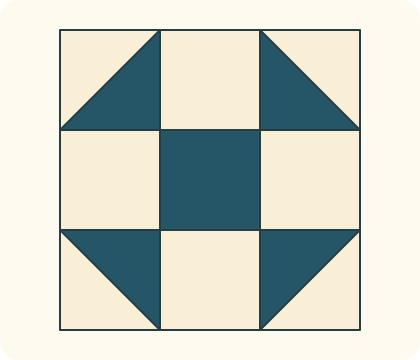 Open diagram at full size ↗
Image source & credit
Original diagram by Quizpen Source ↗ · Quizpen original artwork. Resized for display.
Reveal answer
Shoo Fly. The corner triangle units distinguish this selected Shoo Fly version from the hourglass side units of the Ohio Star.
Sources for this answer
Which common name fits this full ring of wedge-shaped blades around a circular center?
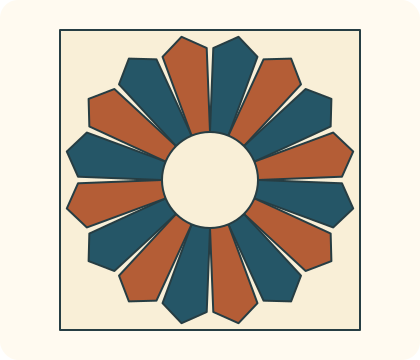 Open diagram at full size ↗
Image source & credit
Original diagram by Quizpen Source ↗ · Quizpen original artwork. Resized for display.
Reveal answer
Dresden Plate. A circular plate of wedge-shaped blades surrounds the center. Blade tips and names vary, so the options here avoid overlapping flower-pattern aliases.
Sources for this answer
Which common name fits wedges spreading through a quarter-circle from one corner?
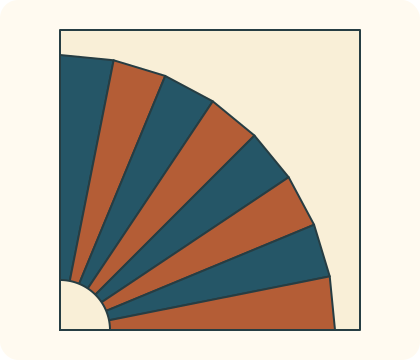 Open diagram at full size ↗
Image source & credit
Original diagram by Quizpen Source ↗ · Quizpen original artwork. Resized for display.
Reveal answer
Fan. This selected Fan version spreads from a corner rather than forming a full circular plate. Wedge tips and exact construction can vary.
Sources for this answer
Which common pattern name best fits these broad parallel stripes?
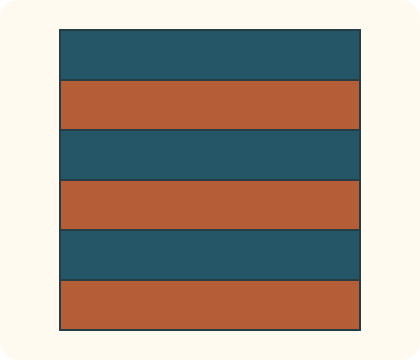 Open diagram at full size ↗
Image source & credit
Original diagram by Quizpen Source ↗ · Quizpen original artwork. Resized for display.
Reveal answer
Bars. The dominant structure is parallel bars. Color choice is secondary to the repeated straight-strip layout.
Sources for this answer
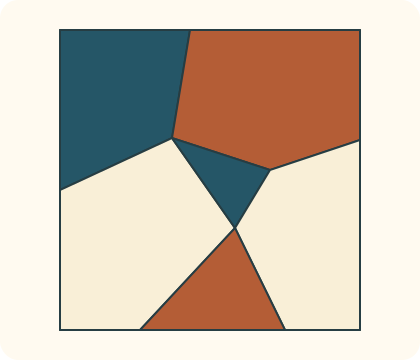
Which term best fits this irregular patchwork schematic?
 Open diagram at full size ↗
Image source & credit
Original diagram by Quizpen Source ↗ · Quizpen original artwork. Resized for display.
Reveal answer
Crazy patchwork. The irregular shapes do not follow the regular repeated grid used by the other options. Crazy-style quilts can also feature decorative seam embroidery.
Sources for this answer
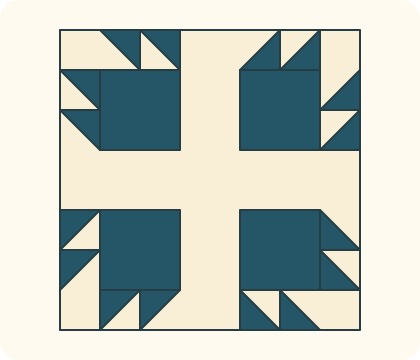
Which common name fits these four square pads edged with triangular claw-like pieces?
 Open diagram at full size ↗
Image source & credit
Original diagram by Quizpen Source ↗ · Quizpen original artwork. Resized for display.
Reveal answer
Bear’s Paw. The selected version groups square pads and triangle claws into four paw-like units. Bear’s Paw designs have variations in layout and sashing.
Sources for this answer
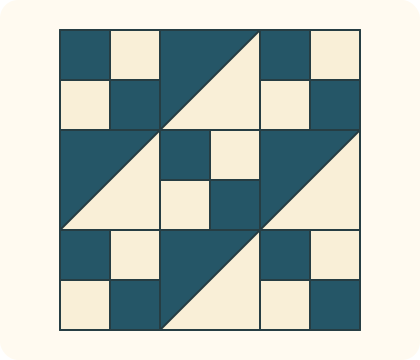
Which common name fits this selected arrangement of small four-patches and larger half-square triangles?
 Open diagram at full size ↗
Image source & credit
Original diagram by Quizpen Source ↗ · Quizpen original artwork. Resized for display.
Reveal answer
Jacob’s Ladder. This selected Jacob’s Ladder version combines checkerboard units with triangular units, producing a diagonal stepped effect.
Sources for this answer
Which common name fits this large eight-point star assembled from many small diamonds?
 Open diagram at full size ↗
Image source & credit
Original diagram by Quizpen Source ↗ · Quizpen original artwork. Resized for display.
Reveal answer
Lone Star. The star’s rays are built from small diamond patches. This identifies the selected Lone Star structure without claiming every eight-point star shares one name.
Sources for this answer
How many equal square patches appear in the simple Nine Patch shown here?
Open diagram at full size ↗Image source & credit
Original diagram by Quizpen Source ↗ · Quizpen original artwork. Resized for display.
Reveal answer
9. Count its three rows of three equal squares: 3 × 3 = 9. This count is for the simple illustrated version.
Sources for this answer
Which framework does the simple Four Patch use?
Open diagram at full size ↗Image source & credit
Original diagram by Quizpen Source ↗ · Quizpen original artwork. Resized for display.
Reveal answer
Two rows by two columns. The displayed four equal squares make a two-by-two grid. A complex block can use a four-patch framework without being this simple checkerboard.
Sources for this answer
What are the four main units in this simple Pinwheel schematic?
Open diagram at full size ↗Image source & credit
Original diagram by Quizpen Source ↗ · Quizpen original artwork. Resized for display.
Reveal answer
Half-square-triangle units. Each square unit is divided diagonally into two triangles. Their orientation creates the turning-blade effect.
Sources for this answer
Which geometric pieces chiefly surround this Log Cabin center?
Open diagram at full size ↗Image source & credit
Original diagram by Quizpen Source ↗ · Quizpen original artwork. Resized for display.
Reveal answer
Rectangular strips. The strips build around the center square. Their sequence and light/dark placement distinguish a Log Cabin layout from a simple grid.
Sources for this answer
How does the museum describe adding strips in Courthouse Steps?
Open diagram at full size ↗Image source & credit
Original diagram by Quizpen Source ↗ · Quizpen original artwork. Resized for display.
Reveal answer
On two opposite sides, then the other opposite sides. The opposite-side pairs produce a symmetrical step arrangement. This construction contrast is more reliable than fabric color alone.
Sources for this answer
In each wide triangular unit shown here, how many background triangles flank the central triangle?
Open diagram at full size ↗Image source & credit
Original diagram by Quizpen Source ↗ · Quizpen original artwork. Resized for display.
Reveal answer
2. There is one background triangle on each side. Count the pieces in the shown unit rather than assuming a universal quilt size.
Sources for this answer
In this Ohio Star version, where are the four hourglass units?
Open diagram at full size ↗Image source & credit
Original diagram by Quizpen Source ↗ · Quizpen original artwork. Resized for display.
Reveal answer
At the middle of the four sides. The hourglass units sit above, below, left and right of the center square. Together their triangles make the eight-point star effect.
Sources for this answer
What distinguishes the selected Shoo Fly schematic from the selected Ohio Star schematic?
Open diagram at full size ↗Image source & credit
Original diagram by Quizpen Source ↗ · Quizpen original artwork. Resized for display.
Reveal answer
Its half-square-triangle units are at the corners. Read the corner triangle units and center square in this selected version. The Ohio Star example instead uses hourglass units at the side middles.
Sources for this answer
Which comparison describes the Fan and Dresden Plate versions used in this quiz?
Reveal answer
A quarter-circle spread versus a complete circular ring. The selected Fan spreads from a corner; the selected Dresden Plate encircles a center. Names and variants need their own documented context.
Sources for this answer
How many outer points does this selected Lone Star have?
Open diagram at full size ↗Image source & credit
Original diagram by Quizpen Source ↗ · Quizpen original artwork. Resized for display.
Reveal answer
8. Count the eight radiating outer tips. Small diamond patches subdivide the rays; they do not add new outer star points.
Sources for this answer
The museum’s naming lesson shows Log Cabin blocks arranged in radiating diamonds. What does Barn Raising name in that example?
Reveal answer
The setting of the blocks. The lesson distinguishes the Log Cabin block from the Barn Raising arrangement. A whole-quilt setting and a single block name are different levels of description.
Sources for this answer
A museum catalogs a quilt as Pinwheel or Fly. What does that demonstrate?
Reveal answer
A documented design can carry more than one name. The Met’s catalog uses both labels in that object’s title. Keep names tied to their documented version rather than marking every alternate name wrong.
Sources for this answer
You rotate a simple four-square checkerboard as one whole unit. What definitely stays the same?
Reveal answer
Its two-by-two square framework. Rotating the unit does not change the count or arrangement of its four square patches. Orientation and setting can affect the appearance of a larger quilt.
Sources for this answer
A quilter changes only the fabric colors in a familiar block. What should you examine before claiming a new structural block design?
Reveal answer
The patch shapes and their arrangement. Structure and documented naming matter. The museum’s examples show how individual color and material choices can personalize familiar designs.
Sources for this answer
Can a familiar block name alone prove who made an antique quilt and its exact date?
Reveal answer
No; those claims need object-specific evidence. A pattern label is not complete provenance. Museum records separately document maker attribution, date range, place and materials, sometimes with uncertainty.
Sources for this answer
Answer key
- Nine Patch. This simple version uses nine equal square patches in three rows and three columns. More complex blocks can also use a nine-patch framework.
- Four Patch. This simple version contains four square patches in two rows and two columns. The name describes its basic framework.
- Pinwheel. The four half-square-triangle units create a turning-blade appearance. Pinwheel variants can have additional piecing or different published names.
- Log Cabin. The surrounding strips suggest stacked logs. Light and dark placement can create many appearances when these blocks are arranged in a quilt.
- Courthouse Steps. The Illinois State Museum explains this opposite-side construction as Courthouse Steps. It differs from working continuously around the center.
- Flying Geese. A central broad triangle and its side triangles form the recognizable unit. The museum records this traditional name; arrangements can vary.
- Ohio Star. This schematic uses a central square and four hourglass units for its star points. It is the Ohio Star version selected for this quiz.
- Shoo Fly. The corner triangle units distinguish this selected Shoo Fly version from the hourglass side units of the Ohio Star.
- Dresden Plate. A circular plate of wedge-shaped blades surrounds the center. Blade tips and names vary, so the options here avoid overlapping flower-pattern aliases.
- Fan. This selected Fan version spreads from a corner rather than forming a full circular plate. Wedge tips and exact construction can vary.
- Bars. The dominant structure is parallel bars. Color choice is secondary to the repeated straight-strip layout.
- Crazy patchwork. The irregular shapes do not follow the regular repeated grid used by the other options. Crazy-style quilts can also feature decorative seam embroidery.
- Bear’s Paw. The selected version groups square pads and triangle claws into four paw-like units. Bear’s Paw designs have variations in layout and sashing.
- Jacob’s Ladder. This selected Jacob’s Ladder version combines checkerboard units with triangular units, producing a diagonal stepped effect.
- Lone Star. The star’s rays are built from small diamond patches. This identifies the selected Lone Star structure without claiming every eight-point star shares one name.
- 9. Count its three rows of three equal squares: 3 × 3 = 9. This count is for the simple illustrated version.
- Two rows by two columns. The displayed four equal squares make a two-by-two grid. A complex block can use a four-patch framework without being this simple checkerboard.
- Half-square-triangle units. Each square unit is divided diagonally into two triangles. Their orientation creates the turning-blade effect.
- Rectangular strips. The strips build around the center square. Their sequence and light/dark placement distinguish a Log Cabin layout from a simple grid.
- On two opposite sides, then the other opposite sides. The opposite-side pairs produce a symmetrical step arrangement. This construction contrast is more reliable than fabric color alone.
- 2. There is one background triangle on each side. Count the pieces in the shown unit rather than assuming a universal quilt size.
- At the middle of the four sides. The hourglass units sit above, below, left and right of the center square. Together their triangles make the eight-point star effect.
- Its half-square-triangle units are at the corners. Read the corner triangle units and center square in this selected version. The Ohio Star example instead uses hourglass units at the side middles.
- A quarter-circle spread versus a complete circular ring. The selected Fan spreads from a corner; the selected Dresden Plate encircles a center. Names and variants need their own documented context.
- 8. Count the eight radiating outer tips. Small diamond patches subdivide the rays; they do not add new outer star points.
- The setting of the blocks. The lesson distinguishes the Log Cabin block from the Barn Raising arrangement. A whole-quilt setting and a single block name are different levels of description.
- A documented design can carry more than one name. The Met’s catalog uses both labels in that object’s title. Keep names tied to their documented version rather than marking every alternate name wrong.
- Its two-by-two square framework. Rotating the unit does not change the count or arrangement of its four square patches. Orientation and setting can affect the appearance of a larger quilt.
- The patch shapes and their arrangement. Structure and documented naming matter. The museum’s examples show how individual color and material choices can personalize familiar designs.
- No; those claims need object-specific evidence. A pattern label is not complete provenance. Museum records separately document maker attribution, date range, place and materials, sometimes with uncertainty.