
Entertainment / 10-question mixed rounds
Chess notation quiz
Decode coordinates, algebraic moves, captures, castling, and promotion.
Mixed rounds: about 3–5 minutes · No timer
10 random questions per mixed round · 30 questions in the full bank below
Published by Quizpen · Explanations include linked supporting reading. See our source-checking process and review limits.
PRACTICE BY SKILL
Choose a focused round
Practice one part of this topic with every question in that skill. Focused practice is separate from ten-question mixed rounds.
Getting your round ready…
BEHIND THE ROUND
A little more about this quiz
English algebraic notation records a move with a piece letter, destination, and any needed capture or check information. Nf3 means a knight moves to f3; dxe5 names a d-file pawn capture on e5. The board position supplies details that a short move record does not show.
The 30 questions form three groups of ten: board coordinates and starting squares, piece letters and move symbols, then castling, promotion, disambiguation, and results. Each round draws ten random questions from the bank. Use the full sheet or group links to concentrate on one skill.
Format details matter. PGN uses O-O with letter O for castling and commonly writes a promotion as e8=Q; FIDE’s printed Appendix C examples use 0-0 and e8Q. This quiz identifies the convention when testing those forms and decodes records without claiming a move is legal in an unseen position.
LEARN THE PATTERN
Decode an algebraic move from left to right
Find the piece or pawn, identify any origin information and capture mark, read the destination, then inspect the ending for check or promotion. English piece letters are used in this bank.
English algebraic notation reference
Use the sample records to connect each symbol with its role. Castling and promotion rows explicitly distinguish PGN forms from FIDE’s printed examples.
| Symbol or example | Meaning | Reading cue |
|---|---|---|
| a–h | File letters | Vertical columns viewed from White’s side. |
| 1–8 | Rank numbers | Horizontal rows; White’s pawns begin on rank 2. |
| e4 | Square e-file, rank 4; or a pawn move there | Context distinguishes a coordinate from a move-list entry. |
| K | King | English piece initial. |
| Q | Queen | English piece initial. |
| R | Rook | English piece initial. |
| B | Bishop | English piece initial. |
| N | Knight | English notation avoids using K for both king and knight. |
| No piece initial | Pawn | A plain pawn move can be written e4. |
| Nf3 | Knight to f3 | The position supplies its origin unless disambiguation is needed. |
| x | Capture | Bxe6 is a bishop capture on e6. |
| dxe5 | D-file pawn captures on e5 | A pawn capture includes its departure file. |
| + | Check | Qh5+ is a queen move to h5 giving check. |
| # | Checkmate | Rxd8# is a rook capture on d8 giving checkmate. |
| O-O (PGN) / 0-0 (FIDE examples) | Kingside castling | Two-part symbol. PGN uses the letter O. |
| O-O-O (PGN) / 0-0-0 (FIDE examples) | Queenside castling | Three-part symbol. FIDE’s printed examples use zero. |
| e8=Q (common PGN-style form) | Pawn promotes to a queen on e8 | FIDE’s printed example form omits =: e8Q. |
| cxd8=N (common PGN-style form) | C-file pawn captures on d8 and promotes to a knight | N records the chosen promotion piece. |
| Nbd2 | B-file knight to d2 | The origin file distinguishes between knights. |
| R1e2 | Rank-1 rook to e2 | The origin rank distinguishes between rooks when needed. |
| 1-0 | White wins | A result; it does not name the reason for the win. |
| 0-1 | Black wins | A result; it does not name the reason for the win. |
| 1/2-1/2 | Draw | A result; it does not name the drawing rule. |
| PGN | A game record with moves and information | Useful for replaying the move sequence. |
| FEN | A board position and associated state | Useful for loading a particular position. |
| a1 / h1 | Dark / light | White’s bottom-right corner h1 is light. |
| b1 / g1 | White’s starting knight squares | The coordinate names stay fixed when the board is viewed from Black’s side. |
These examples teach notation, not move legality in an unspecified position. English piece initials are used; other languages can use different initials.
Reference sources: FIDE Laws of Chess: Appendix C, algebraic notation · Chess.com: chessboard coordinates · Chess.com: chess pieces and starting squares · Chess.com: chess notation · Chess.com: pawn promotion and its notation · Chess.com Support: PGN and FEN
Check what you remember
Look away from the table. Try each question, then open it to check your answer.
Decode “Nf3” without inventing a starting square.Show answer
A knight moves to f3. The position or added origin information is needed to identify its starting square.
What does the e specify in “exd5”?Show answer
The capturing pawn’s departure file; the pawn captures on d5.
In a common PGN-style promotion, what does “=R” mean?Show answer
The pawn promotes to a rook. R is the chosen new piece, not the captured piece.
Board coordinates: questions 1–10
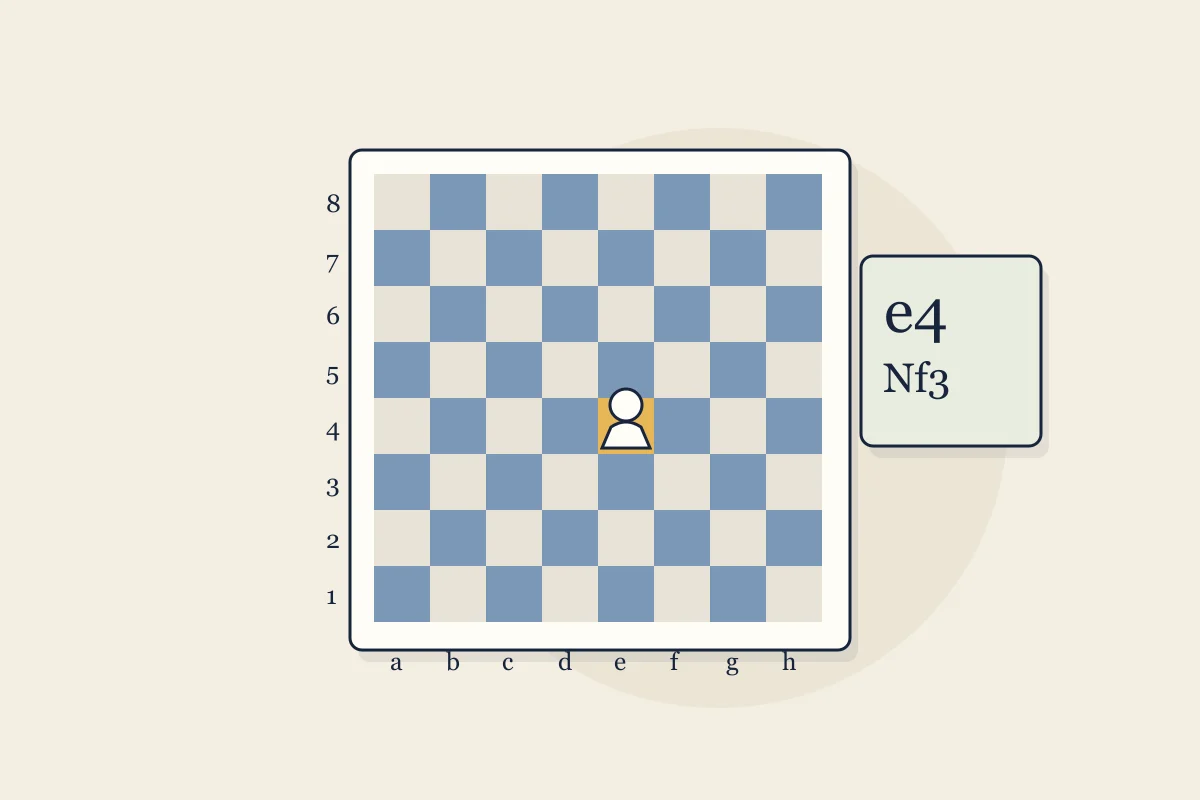
Files are vertical columns labeled a through h; ranks are horizontal rows numbered 1 through 8. A square name puts its file first and rank second, so e4 is the intersection of the e-file and rank 4. The names remain fixed when the board is viewed from Black’s side.
Orient a standard board with a light square on White’s bottom-right: h1 is light and a1 is dark. White’s pawns start on rank 2, and White’s knights start on b1 and g1. English notation uses N for a knight because K is reserved for the king.
- A coordinate can identify a square; in a move list, a plain e4 also denotes a pawn move there.
- A noncapturing pawn move omits a piece initial.
Pieces, captures, and check: questions 11–20
The English piece letters are K, Q, R, B, and N for king, queen, rook, bishop, and knight. In Nf3, N gives the piece and f3 gives the destination. A pawn has no piece initial in an ordinary move.
The symbol x marks a capture, + marks check, and # commonly marks checkmate. Bxe6 is a bishop capture on e6; dxe5 is a pawn capture from the d-file to e5. Rxd8# records both a capture and checkmate. A symbol tells you the stated action or result, but the board is needed to verify its legality.
- A pawn capture includes its departure file.
- Check and checkmate are different endings: read + and # separately from x.
Special moves and game records: questions 21–30
Kingside castling uses the two-part symbol O-O in PGN; queenside castling uses O-O-O. FIDE’s printed examples use zero characters instead. Promotion records the new piece: common PGN-style e8=Q chooses a queen, and cxd8=N combines a capture with knight promotion.
If identical pieces can reach the same destination, origin information distinguishes them. Nbd2 selects the b-file knight, while R1e2 selects the rook on rank 1 when rank disambiguation is needed. Results 1-0, 0-1, and 1/2-1/2 record a White win, Black win, and draw respectively.
- PGN stores a game’s move sequence and information; FEN describes a particular position and its state.
- A result marker does not tell you whether a decisive game ended by checkmate, resignation, or another cause.
- Questions about =Q or =N explicitly use the common PGN-style convention.
Put it into practice
Further reading: FIDE Laws of Chess: Appendix C, algebraic notation · Chess.com: chessboard coordinates · Chess.com: chess pieces and starting squares · Chess.com: chess notation · Chess.com: pawn promotion and its notation · Chess.com: PGN game notation · Chess.com Support: PGN and FEN
QUESTIONS & ANSWERS
Chess notation quiz: the full question sheet
Decode English algebraic notation, board coordinates, captures, promotion, and game results with a 30-question bank. Each round draws ten random questions; the full sheet offers three sets of ten.
By Quizpen · Updated
Browse the full question bank30 questions & answers
On a chessboard, what is a file?
Reveal answer
A vertical column of squares. Files are the board’s vertical columns and use letters a through h. Ranks run horizontally and use numbers, so a coordinate combines one file with one rank.
Sources for this answer
Which part of the chessboard is called a rank?
Reveal answer
A horizontal row of squares. A rank is a horizontal row, numbered 1 through 8. The numbering stays tied to the board coordinates rather than changing according to whose turn it is.
Sources for this answer
In the square name “e4,” what do the letter and number identify?
Reveal answer
The e-file and the fourth rank. Algebraic square names place the file letter first and the rank number second. E4 therefore identifies one square where the e-file meets rank 4.
Sources for this answer
Which letter identifies a knight in English algebraic chess notation?
Reveal answer
N. English algebraic notation uses N for knight. K is reserved for king; other language conventions can use different piece initials, so this quiz explicitly uses English letters.
Sources for this answer
How is an ordinary pawn move to e4 written in algebraic notation?
Reveal answer
e4. Pawn moves omit a piece letter, leaving the destination square for a noncapture. Captures add the pawn’s departure file and x, such as dxe4.
Sources for this answer
A player views the board from Black’s side. What happens to the names of its squares?
Reveal answer
The square names stay the same. Coordinates remain fixed when you change viewing direction. From White’s side files run a to h left to right; from Black’s side the same files appear in the opposite visual order.
Sources for this answer
At the standard starting position, which rank holds White’s pawns?
Reveal answer
Rank 2. White’s pawns begin on the second rank, ahead of White’s other pieces on rank 1. Black’s pawns start on rank 7, so the side must be specified.
Sources for this answer
What color is the square a1 on a correctly arranged chessboard?
Reveal answer
Dark. The corner h1 is light, and the alternating eight-square first rank makes a1 dark. Board colors are part of the fixed arrangement and do not change during play.
Sources for this answer
Which corner square is light at White’s bottom-right when the board is set correctly?
Reveal answer
h1. H1 is White’s bottom-right corner and is light. “Light on the right” helps orient the board; the letters and numbers then provide fixed names for every square.
Sources for this answer
Where do White’s knights start in the standard initial position?
Reveal answer
b1 and g1. White’s knights start on b1 and g1. The bishops occupy c1 and f1, while the rooks occupy the corners a1 and h1, so piece letters and square names must be read together.
Sources for this answer
Which piece does the letter R identify in English algebraic notation?
Reveal answer
Rook. R identifies a rook in English notation. For example, Re2 names a rook move to e2; extra origin information is added when needed to distinguish between rooks.
Sources for this answer
In English algebraic notation, what does Q stand for?
Reveal answer
Queen. Q is the English notation letter for queen. The following coordinate gives the destination, while capture and check symbols add information about the recorded move.
Sources for this answer
Which English piece letter belongs to a bishop?
Reveal answer
B. B identifies a bishop in English algebraic notation. A record such as Bb5 combines the piece letter with its destination; it does not name the square from which the bishop started.
Sources for this answer
What piece is identified by K in English chess notation?
Reveal answer
King. K means king. N is used for the knight, avoiding a collision between their English initials; this quiz uses that convention throughout.
Sources for this answer
What does the move record “Nf3” describe?
Reveal answer
A knight moves to f3. N identifies the knight and f3 gives its destination. The starting square must be established from the position or additional disambiguation; the record alone is not a board diagram.
Sources for this answer
With no piece letter or capture mark, what does “e4” describe in a move list?
Reveal answer
A pawn moves to e4. A plain destination such as e4 denotes a noncapturing pawn move. The board position supplies its origin; an e-file pawn capture would include its departure file and x.
Sources for this answer
In “Bxe6,” what information does the x add?
Reveal answer
The bishop captures on e6. The letter B names a bishop, x marks a capture, and e6 is the destination. A capture symbol describes the action; a separate + or # would identify check or checkmate.
Sources for this answer
How should “dxe5” be decoded?
Reveal answer
A pawn from the d-file captures on e5. Pawn captures name the departure file before x and then the destination. Thus dxe5 starts with a d-file pawn and ends on e5 after a capture.
Sources for this answer
What does the plus sign in “Qh5+” report?
Reveal answer
The move gives check. The + sign reports check after the move. Qh5 supplies the queen’s destination; checkmate is commonly marked #, and a capture would be indicated by x.
Sources for this answer
What does “Rxd8#” report in common algebraic notation?
Reveal answer
A rook captures on d8 and gives checkmate. R names the rook, x identifies a capture on d8, and # indicates checkmate. These symbols describe the recorded result without showing the full position that produced it.
Sources for this answer
Which castling move is written O-O in PGN, or 0-0 in FIDE’s printed examples?
Reveal answer
Kingside castling. The two-part castling symbol denotes kingside castling, toward the h-file rook in the standard position. PGN uses capital letter O, while FIDE Appendix C prints zero characters.
Sources for this answer
What does O-O-O in PGN, or 0-0-0 in FIDE’s printed examples, mean?
Reveal answer
Queenside castling. The three-part symbol denotes queenside castling, toward the a-file rook in the standard position. Its length distinguishes it from kingside O-O; it does not count three king moves.
Sources for this answer
In common PGN-style notation, what does “e8=Q” describe?
Reveal answer
A pawn reaches e8 and promotes to a queen. E8 is the pawn’s destination and =Q identifies promotion to a queen. FIDE’s printed Appendix C examples omit the equals sign, so the question specifies the common PGN-style form.
Sources for this answer
In common PGN-style notation, how should “cxd8=N” be read?
Reveal answer
A c-file pawn captures on d8 and promotes to a knight. The initial c identifies the pawn’s departure file, x marks capture on d8, and =N means promotion to a knight. Underpromotion may choose a knight, bishop, or rook rather than a queen.
Sources for this answer
If two knights can reach d2, what does the b in “Nbd2” identify?
Reveal answer
The moving knight’s departure file. Nbd2 selects the knight on the b-file. When pieces of the same kind can reach the same square, departure information resolves the ambiguity; the final d2 remains the destination.
Sources for this answer
What does the 1 in “R1e2” distinguish?
Reveal answer
The rook departing from rank 1. R1e2 names the rook whose origin is on rank 1 and whose destination is e2. Rank disambiguation is used when the relevant rooks share a file and can reach the same square.
Sources for this answer
Which game result does “1-0” record?
Reveal answer
White wins. A 1-0 result records a win for White. It is a game-result marker, so it does not identify whether the win came from checkmate, resignation, or another decisive ending.
Sources for this answer
What does the result marker “0-1” mean?
Reveal answer
Black wins. A 0-1 result records a win for Black. Keep result markers separate from castling notation: 0-0 is a FIDE castling symbol, not a game result.
Sources for this answer
Which result is recorded by “1/2-1/2”?
Reveal answer
A draw. The split result 1/2-1/2 means a draw. The score alone does not specify the reason, which might be agreement, stalemate, or another applicable drawing rule.
Sources for this answer
Which statement correctly distinguishes PGN from FEN?
Reveal answer
PGN records a game’s move sequence; FEN describes a position. PGN can store game information and an algebraic move list, while FEN encodes a board position and related state. Use PGN to replay a game and FEN to load a particular position.
Sources for this answer
Answer key
- A vertical column of squares. Files are the board’s vertical columns and use letters a through h. Ranks run horizontally and use numbers, so a coordinate combines one file with one rank.
- A horizontal row of squares. A rank is a horizontal row, numbered 1 through 8. The numbering stays tied to the board coordinates rather than changing according to whose turn it is.
- The e-file and the fourth rank. Algebraic square names place the file letter first and the rank number second. E4 therefore identifies one square where the e-file meets rank 4.
- N. English algebraic notation uses N for knight. K is reserved for king; other language conventions can use different piece initials, so this quiz explicitly uses English letters.
- e4. Pawn moves omit a piece letter, leaving the destination square for a noncapture. Captures add the pawn’s departure file and x, such as dxe4.
- The square names stay the same. Coordinates remain fixed when you change viewing direction. From White’s side files run a to h left to right; from Black’s side the same files appear in the opposite visual order.
- Rank 2. White’s pawns begin on the second rank, ahead of White’s other pieces on rank 1. Black’s pawns start on rank 7, so the side must be specified.
- Dark. The corner h1 is light, and the alternating eight-square first rank makes a1 dark. Board colors are part of the fixed arrangement and do not change during play.
- h1. H1 is White’s bottom-right corner and is light. “Light on the right” helps orient the board; the letters and numbers then provide fixed names for every square.
- b1 and g1. White’s knights start on b1 and g1. The bishops occupy c1 and f1, while the rooks occupy the corners a1 and h1, so piece letters and square names must be read together.
- Rook. R identifies a rook in English notation. For example, Re2 names a rook move to e2; extra origin information is added when needed to distinguish between rooks.
- Queen. Q is the English notation letter for queen. The following coordinate gives the destination, while capture and check symbols add information about the recorded move.
- B. B identifies a bishop in English algebraic notation. A record such as Bb5 combines the piece letter with its destination; it does not name the square from which the bishop started.
- King. K means king. N is used for the knight, avoiding a collision between their English initials; this quiz uses that convention throughout.
- A knight moves to f3. N identifies the knight and f3 gives its destination. The starting square must be established from the position or additional disambiguation; the record alone is not a board diagram.
- A pawn moves to e4. A plain destination such as e4 denotes a noncapturing pawn move. The board position supplies its origin; an e-file pawn capture would include its departure file and x.
- The bishop captures on e6. The letter B names a bishop, x marks a capture, and e6 is the destination. A capture symbol describes the action; a separate + or # would identify check or checkmate.
- A pawn from the d-file captures on e5. Pawn captures name the departure file before x and then the destination. Thus dxe5 starts with a d-file pawn and ends on e5 after a capture.
- The move gives check. The + sign reports check after the move. Qh5 supplies the queen’s destination; checkmate is commonly marked #, and a capture would be indicated by x.
- A rook captures on d8 and gives checkmate. R names the rook, x identifies a capture on d8, and # indicates checkmate. These symbols describe the recorded result without showing the full position that produced it.
- Kingside castling. The two-part castling symbol denotes kingside castling, toward the h-file rook in the standard position. PGN uses capital letter O, while FIDE Appendix C prints zero characters.
- Queenside castling. The three-part symbol denotes queenside castling, toward the a-file rook in the standard position. Its length distinguishes it from kingside O-O; it does not count three king moves.
- A pawn reaches e8 and promotes to a queen. E8 is the pawn’s destination and =Q identifies promotion to a queen. FIDE’s printed Appendix C examples omit the equals sign, so the question specifies the common PGN-style form.
- A c-file pawn captures on d8 and promotes to a knight. The initial c identifies the pawn’s departure file, x marks capture on d8, and =N means promotion to a knight. Underpromotion may choose a knight, bishop, or rook rather than a queen.
- The moving knight’s departure file. Nbd2 selects the knight on the b-file. When pieces of the same kind can reach the same square, departure information resolves the ambiguity; the final d2 remains the destination.
- The rook departing from rank 1. R1e2 names the rook whose origin is on rank 1 and whose destination is e2. Rank disambiguation is used when the relevant rooks share a file and can reach the same square.
- White wins. A 1-0 result records a win for White. It is a game-result marker, so it does not identify whether the win came from checkmate, resignation, or another decisive ending.
- Black wins. A 0-1 result records a win for Black. Keep result markers separate from castling notation: 0-0 is a FIDE castling symbol, not a game result.
- A draw. The split result 1/2-1/2 means a draw. The score alone does not specify the reason, which might be agreement, stalemate, or another applicable drawing rule.
- PGN records a game’s move sequence; FEN describes a position. PGN can store game information and an algebraic move list, while FEN encodes a board position and related state. Use PGN to replay a game and FEN to load a particular position.