
Language & music / 10-question mixed rounds
Rhyme scheme quiz
Find AABB, ABAB, and ABBA patterns in original verses, with explained answers.
Mixed rounds: about 3–5 minutes · No timer
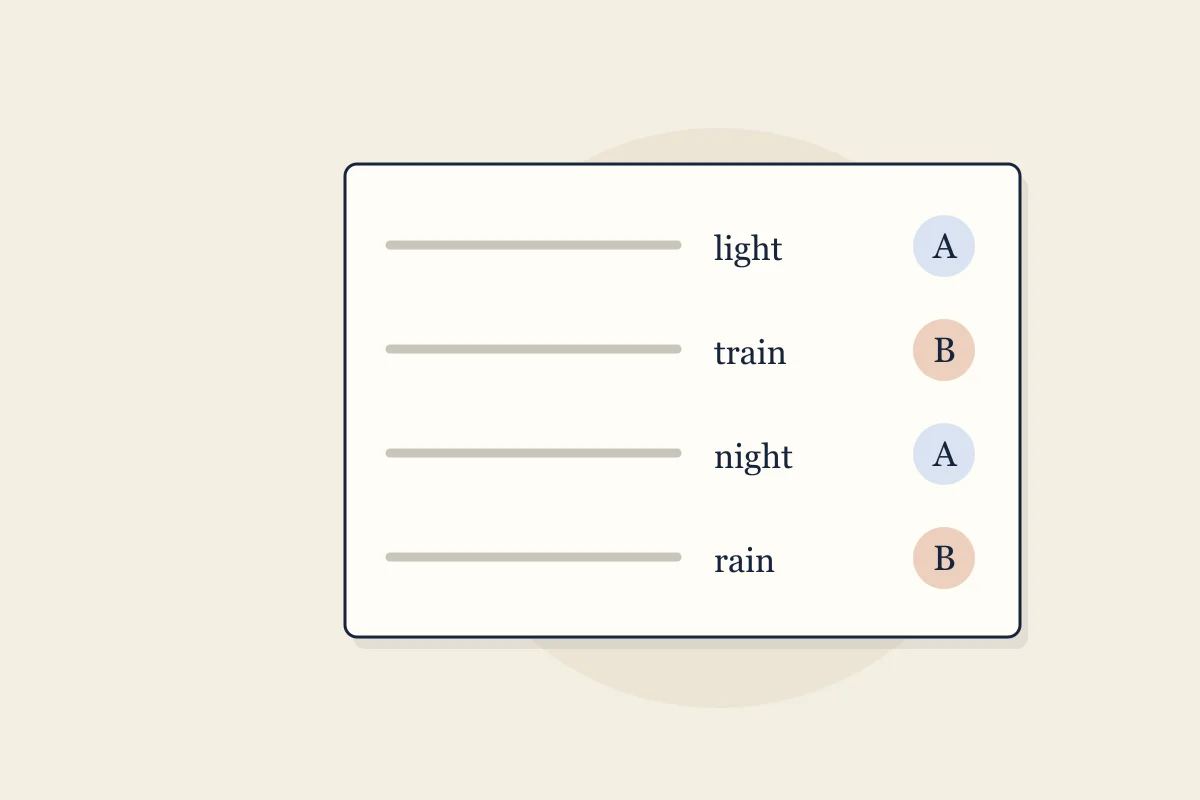
10 random questions per mixed round · 30 questions in the full bank below
Published by Quizpen · Explanations include linked supporting reading. See our source-checking process and review limits.
PRACTICE BY SKILL
Choose a focused round
Practice one part of this topic with every question in that skill. Focused practice is separate from ten-question mixed rounds.
Getting your round ready…
BEHIND THE ROUND
A little more about this quiz
A rhyme scheme records the order of matching sounds at the ends of a poem’s lines. Give the first ending sound A, the next new sound B, and keep the earlier letter whenever its sound returns. In a stanza ending boat, sun, coat, fun, the first and third endings rhyme, and the second and fourth rhyme: ABAB.
This 30-question rhyme scheme quiz progresses from hearing rhymes to labeling original short stanzas and choosing an ending that completes a pattern. Questions 1–10 introduce the sound labels, 11–20 apply them to verses, and 21–30 ask you to complete or correct patterns. Each random round draws ten questions; the numbered sheet includes the full bank and answer explanations.
Use the slashes in a verse question as line breaks. Read the last word of each line aloud before choosing a label, because spelling alone can mislead you: blue rhymes with shoe, while love does not exactly rhyme with move in ordinary US English. All practice verses here are original, and the reference below gives a quick way to check the common patterns.
LEARN THE PATTERN
How to find a rhyme scheme
Separate the last words from the rest of the verse, compare their spoken endings, and label one sound at a time. Then read the labels in line order.
Common rhyme schemes with simple end-word examples
The letters name ending sounds in order. These examples are line-ending words, not complete poems; compare them aloud and cover the final column to test yourself.
| Scheme | Four line endings | Matching lines |
|---|---|---|
| AABB | cat / hat / bee / tree | 1 with 2; 3 with 4 |
| ABAB | boat / sun / coat / fun | 1 with 3; 2 with 4 |
| ABBA | rain / glow / snow / train | 1 with 4; 2 with 3 |
| ABCB | wall / ring / head / sing | 2 with 4 |
| AAAA | star / far / jar / car | All four share one sound |
| ABCD | book / tree / sun / rain | No repeated ending rhyme in this example |
The quiz uses ordinary US English pronunciation and exact end rhymes. A poet may also use slant rhyme or choose not to repeat ending sounds.
Reference sources: Academy of American Poets: rhyme and end rhyme · Poetry Foundation: rhyme schemes, end rhyme, and internal rhyme
Check what you remember
Look away from the table. Try each question, then open it to check your answer.
Four lines end door, key, floor, me. What is the rhyme scheme?Show answer
ABAB. Door/floor share A, and key/me share B.
An ABBA verse starts with day, moon, soon. Which sound must its final line use?Show answer
The A sound in day; play would complete day/moon/soon/play.
In “At night the bright kite fills the air / I watch it from my chair,” which words determine the end rhyme?Show answer
Air and chair. Night, bright, and kite rhyme inside the first line; end-rhyme labels use the line endings.
Worked ABAB example: label one line at a time
Read this original four-line stanza aloud. Each bullet is one line of the poem, followed by its end-rhyme label and the reason for it.
- “The last small boat comes into sight.” — A: sight introduces the first ending sound.
- “A gull flies low across the bay.” — B: bay introduces a different ending sound.
- “The harbor lamps begin to light.” — A: light rhymes with sight, so reuse A.
- “We fold our sails and end the day.” — B: day rhymes with bay, so reuse B.
Hear and label the endings: questions 1–10
Start by identifying the sound, rather than the spelling. Light/night rhyme; blue/shoe also rhyme despite their different written endings. Assign A to the first sound. If line two introduces a different sound, assign B; when A’s sound returns, use A again.
- A letter represents one rhyming sound family, not one individual word.
- An ABCB pattern repeats the second line’s sound in the fourth line.
Read original stanzas: questions 11–20
Mark the final word of each line before deciding whether the matching lines are adjacent, alternating, or outside a middle pair. Lake/wake/hill/still gives AABB; tree/gate/me/wait gives ABAB. In ABBA, the first and fourth endings match, while the second and third form another pair.
- Continue the same labels through a longer stanza: lake/night/wake/light/bee/tree becomes ABABCC.
- Repeated words are not required: four different ending words can all share A.
Complete and correct patterns: questions 21–30
Use the required letter to find the sound that a missing ending must match. In sky/tree/fly/blank with an ABAB target, the fourth ending needs the B sound in tree. Check a proposed answer by relabeling all four endings from the beginning. Internal rhymes can make a line musical while leaving its end-rhyme scheme unchanged.
- A new ending sound gets a new letter even if an earlier word looks similar.
- Try the printable sheet, then explain one corrected pattern without looking at its answer.
Check three common mistakes
The worked stanza is ABAB because its matching lines alternate. Move the light line directly after the sight line, followed by the bay and day lines, and the same two sound families give AABB. The letters record the order of sounds, not a permanent label for a particular word.
- Count lines, not sentences: a sentence can run across more than one verse line. The slashes in this quiz mark those line breaks.
- Listen beyond spelling: love and move look similar but do not form an exact rhyme in the ordinary US English pronunciation used here.
- Ignore a rhyme inside a line when labeling end rhymes. A scheme also does not measure rhythm, syllable count, or the poem’s subject.
Put it into practice
- Try a ten-question mixed round
- Practice hearing and labeling end sounds
- Identify rhyme schemes in original stanzas
- Complete and correct rhyme patterns
- Build a rhyme scheme worksheet with answers
- Read ending-sound questions 1–10
- Read original-stanza questions 11–20
- Read completion and correction questions 21–30
Further reading: Academy of American Poets: rhyme and end rhyme · Poetry Foundation: rhyme schemes, end rhyme, and internal rhyme
QUESTIONS & ANSWERS
Rhyme scheme quiz: the full question sheet
Practice end-rhyme patterns with 30 questions, original short verses, and explained answers. Each round draws ten; the full sheet groups sound labels, stanza patterns, and revision practice.
By Quizpen · Updated
Browse the full question bank30 questions & answers
When identifying a poem’s end-rhyme scheme, what should you compare?
Reveal answer
The sounds at the ends of its lines. End-rhyme labels track matching line-ending sounds. Starting letters, titles, and punctuation do not determine that pattern.
Which pair is an exact rhyme in ordinary US English?
Reveal answer
light and night. Light and night share the stressed vowel and ending sounds. Sharing an initial letter, as light and lamp do, is a different kind of resemblance.
Sources for this answer
Which pair rhymes even though its endings are spelled differently?
Reveal answer
blue and shoe. Blue and shoe end in the same spoken sound. Rhyme is heard, so matching spellings are not required.
Sources for this answer
Why do “love” and “move” not form an exact rhyme in ordinary US English?
Reveal answer
Their stressed vowel sounds differ. Love has the vowel sound in “cup”; move has the vowel sound in “food.” Similar written endings cannot override that sound difference.
Sources for this answer
A stanza’s first line ends in “day” and is labeled A. The second ends in “play.” Which label belongs to the second line?
Reveal answer
A. Play rhymes with day, so it keeps the label already assigned to that sound. A new label is needed only for a new ending sound.
Line endings are “moon, tree, soon.” If moon is A and tree is B, what is the third line’s label?
Reveal answer
A. Soon returns to the sound in moon. Its label is A even though another sound appeared between those lines.
What is the rhyme scheme of these four line endings: “cat, hat, bee, tree”?
Reveal answer
AABB. Cat and hat share A; bee and tree share a different sound, B. The two neighboring rhyming pairs produce AABB.
What is the rhyme scheme of these four line endings: “boat, sun, coat, fun”?
Reveal answer
ABAB. Boat and coat match in lines one and three. Sun and fun match in lines two and four, creating the alternating pattern ABAB.
What pattern do the line endings “rain, glow, snow, train” make?
Reveal answer
ABBA. Rain and train form the outer A pair; glow and snow form the middle B pair. The matching sounds are arranged ABBA.
Which lines rhyme with each other in an ABCB stanza?
Reveal answer
The second and fourth lines. B appears in positions two and four. A and C identify other ending sounds in this four-line pattern.
Find the rhyme scheme. Each slash starts a new line: “A paper boat floats on the lake / It leaves a little curling wake / We watch it from a grassy hill / The evening air is calm and still.”
Reveal answer
AABB. Lake and wake make the A pair. Hill and still make the B pair. Labeling the four endings in order gives AABB.
Label this original stanza. Each slash starts a new line: “A sparrow settles in a tree / A puppy waits beside the gate / The sparrow sings a tune for me / The puppy cannot bear to wait.”
Reveal answer
ABAB. Tree and me rhyme across lines one and three; gate and wait rhyme across lines two and four. The sounds alternate: ABAB.
What scheme fits this stanza? Slashes separate lines: “We watch our paper kite in flight / Above the branches of a tree / It dips a little close to me / Then rises in the fading light.”
Reveal answer
ABBA. Flight and light provide the outer A sounds. Tree and me provide the inner B sounds. The sequence is ABBA.
What pattern fits this verse? Slashes separate lines: “A robin rests upon the wall / A bell begins to ring / The robin turns its tiny head / And then begins to sing.”
Reveal answer
ABCB. The endings are wall, ring, head, sing. Only ring and sing match, so the labels are A, B, C, B.
Read the four lines separated by slashes: “A cloud drifts slowly through the sky / A beetle walks along the ground / A gull sails up and passes by / I watch it from my window.” What is the scheme?
Reveal answer
ABAC. Sky and by share A. Ground supplies B; window supplies a third ending sound, C. The complete pattern is ABAC.
Which scheme fits these lines? Slashes mark line breaks: “I watched a sleepy kitten blink / It gave one lazy little wink / Then curled beside the kitchen sink / While I went out of town.”
Reveal answer
AAAB. Blink, wink, and sink all share the first ending sound. Town introduces a different sound on line four, so the scheme is AAAB.
What is the scheme of this original verse? Slashes separate lines: “We make a castle in the sand / And give our friends a little show / A beetle climbs a fallen leaf / Its visit is extremely brief.”
Reveal answer
ABCC. Sand and show introduce A and B. Leaf and brief rhyme with each other, adding C twice: ABCC.
These six lines end in “lake, night, wake, light, bee, tree.” What is their complete rhyme scheme?
Reveal answer
ABABCC. Lake/wake receive A, night/light receive B, and bee/tree receive the new sound C. Keep the same labels throughout all six lines.
A four-line verse ends in “star, far, jar, car.” Which scheme records the shared ending sound?
Reveal answer
AAAA. Every ending rhymes with the first one, so each receives A. Four different words can still belong to one rhyme family.
In a stanza labeled ABBA, which ending must rhyme with line one?
Reveal answer
Line four’s ending. Both the first and fourth lines are A. The two middle lines share the separate B sound.
A new ABAB stanza ends its first three lines with “sky, tree, fly.” Which word would complete the B rhyme on line four?
Reveal answer
me. The fourth line must match the second line’s tree sound. Me does that; high would return to the A sound in sky and fly.
To finish an AABB verse whose first three endings are “boat, coat, cat,” which final word fits?
Reveal answer
hat. The final line needs the B sound introduced by cat. Hat supplies it, while float would reuse the earlier boat/coat sound.
A poet wants ABBA. The first three endings are “moon, snow, glow.” Which fourth ending completes the pattern?
Reveal answer
soon. An ABBA stanza returns to A at the end. Soon matches moon; show would add another B instead.
For an ABCB pattern, a verse begins with the endings “desk, rain, clock.” Which ending belongs on line four?
Reveal answer
train. Line four carries B, the sound already introduced by rain. Train rhymes with rain; rock would repeat C instead.
Four line endings are “stone, alone, tree, phone.” Which label sequence is correct?
Reveal answer
AABA. Stone, alone, and phone share A. Tree is the separate B sound in the third position, giving AABA.
A student labels “sun, cat, fun, hat” as AABB. What change fixes the labels?
Reveal answer
Change them to ABAB. Fun matches sun, while hat matches cat. The two sound families alternate rather than appearing in adjacent pairs.
In the two-line verse “At night the bright kite fills the air / My brother watches from his chair,” which words determine its end rhyme?
Reveal answer
air and chair. The line endings are air and chair. Night, bright, and kite rhyme inside the first line, but internal rhymes do not determine the end-rhyme labels.
Sources for this answer
A poem’s line endings are “glow, boat, slow, coat.” A student wants to label every different word with a new letter. Why is that incorrect?
Reveal answer
Different words can share one rhyming sound. Glow/slow share A and boat/coat share B. Rhyme labels name sound families, not individual word spellings.
A four-line stanza ends in “book, tree, sun, rain,” with no repeated rhyming ending. What labels record that?
Reveal answer
ABCD. Each of the four endings introduces a different sound, so each receives a new label. A stanza can be written without an end-rhyme pattern that repeats.
Sources for this answer
Find the scheme of this final verse. Slashes separate lines: “The lantern glows beside the door / Its golden light falls on the floor / We leave a note beneath the tree / A little gift for you and me.”
Reveal answer
AABB. Door and floor make A; tree and me make B. The verse ends with two adjacent rhyming pairs, AABB.
Answer key
- The sounds at the ends of its lines. End-rhyme labels track matching line-ending sounds. Starting letters, titles, and punctuation do not determine that pattern.
- light and night. Light and night share the stressed vowel and ending sounds. Sharing an initial letter, as light and lamp do, is a different kind of resemblance.
- blue and shoe. Blue and shoe end in the same spoken sound. Rhyme is heard, so matching spellings are not required.
- Their stressed vowel sounds differ. Love has the vowel sound in “cup”; move has the vowel sound in “food.” Similar written endings cannot override that sound difference.
- A. Play rhymes with day, so it keeps the label already assigned to that sound. A new label is needed only for a new ending sound.
- A. Soon returns to the sound in moon. Its label is A even though another sound appeared between those lines.
- AABB. Cat and hat share A; bee and tree share a different sound, B. The two neighboring rhyming pairs produce AABB.
- ABAB. Boat and coat match in lines one and three. Sun and fun match in lines two and four, creating the alternating pattern ABAB.
- ABBA. Rain and train form the outer A pair; glow and snow form the middle B pair. The matching sounds are arranged ABBA.
- The second and fourth lines. B appears in positions two and four. A and C identify other ending sounds in this four-line pattern.
- AABB. Lake and wake make the A pair. Hill and still make the B pair. Labeling the four endings in order gives AABB.
- ABAB. Tree and me rhyme across lines one and three; gate and wait rhyme across lines two and four. The sounds alternate: ABAB.
- ABBA. Flight and light provide the outer A sounds. Tree and me provide the inner B sounds. The sequence is ABBA.
- ABCB. The endings are wall, ring, head, sing. Only ring and sing match, so the labels are A, B, C, B.
- ABAC. Sky and by share A. Ground supplies B; window supplies a third ending sound, C. The complete pattern is ABAC.
- AAAB. Blink, wink, and sink all share the first ending sound. Town introduces a different sound on line four, so the scheme is AAAB.
- ABCC. Sand and show introduce A and B. Leaf and brief rhyme with each other, adding C twice: ABCC.
- ABABCC. Lake/wake receive A, night/light receive B, and bee/tree receive the new sound C. Keep the same labels throughout all six lines.
- AAAA. Every ending rhymes with the first one, so each receives A. Four different words can still belong to one rhyme family.
- Line four’s ending. Both the first and fourth lines are A. The two middle lines share the separate B sound.
- me. The fourth line must match the second line’s tree sound. Me does that; high would return to the A sound in sky and fly.
- hat. The final line needs the B sound introduced by cat. Hat supplies it, while float would reuse the earlier boat/coat sound.
- soon. An ABBA stanza returns to A at the end. Soon matches moon; show would add another B instead.
- train. Line four carries B, the sound already introduced by rain. Train rhymes with rain; rock would repeat C instead.
- AABA. Stone, alone, and phone share A. Tree is the separate B sound in the third position, giving AABA.
- Change them to ABAB. Fun matches sun, while hat matches cat. The two sound families alternate rather than appearing in adjacent pairs.
- air and chair. The line endings are air and chair. Night, bright, and kite rhyme inside the first line, but internal rhymes do not determine the end-rhyme labels.
- Different words can share one rhyming sound. Glow/slow share A and boat/coat share B. Rhyme labels name sound families, not individual word spellings.
- ABCD. Each of the four endings introduces a different sound, so each receives a new label. A stanza can be written without an end-rhyme pattern that repeats.
- AABB. Door and floor make A; tree and me make B. The verse ends with two adjacent rhyming pairs, AABB.