
Language & music / 10-question mixed rounds
Musical dynamics quiz
Read p, f, crescendo, and other loudness markings in simple musical contexts.
Mixed rounds: about 3–5 minutes · No timer
10 random questions per mixed round · 30 questions in the full bank below
Published by Quizpen · Explanations include linked supporting reading. See our source-checking process and review limits.
PRACTICE BY SKILL
Choose a focused round
Practice one part of this topic with every question in that skill. Focused practice is separate from ten-question mixed rounds.
Getting your round ready…
BEHIND THE ROUND
A little more about this quiz
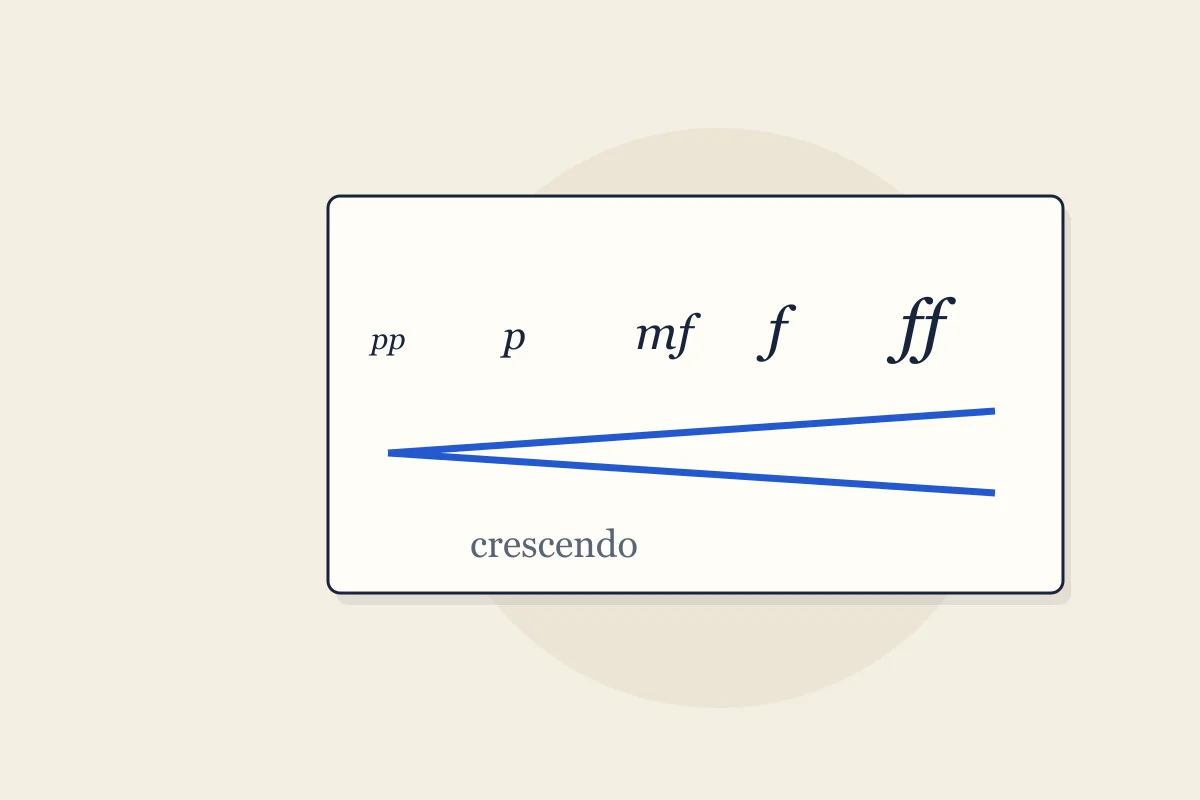
Dynamics describe how loud or soft music should be. The markings p and f mean piano and forte: soft and loud. Adding mezzo gives a medium level, and adding -issimo gives a more extreme one. Crescendo and decrescendo describe a change across a passage, so they tell you where the loudness is moving rather than naming one fixed level.
This 30-question musical dynamics quiz begins with six common levels, then practices hairpins and changing loudness, and finishes with short performance descriptions. Questions 1–10 cover pp through ff, 11–20 follow dynamic changes, and 21–30 separate loudness from tempo and articulation. Each random round draws ten questions; the full sheet and reference chart support a longer practice session.
Read dynamic markings as relative directions within a musical context. They do not assign one universal decibel reading to every instrument. A fast passage can be very soft, and a slow passage can be loud. The questions use written instructions and original scenarios so you can focus on notation before applying the same vocabulary in listening or music lessons.
LEARN THE PATTERN
Read musical loudness one instruction at a time
First identify a level, then follow any change, and finally combine it with the other performance directions.
Musical dynamics chart: levels and changes
Read the first six levels from softer to louder. The final directions describe how a level changes over time.
| Marking | Name | Direction |
|---|---|---|
| pp | pianissimo | Very soft |
| p | piano | Soft |
| mp | mezzo piano | Medium soft |
| mf | mezzo forte | Medium loud |
| f | forte | Loud |
| ff | fortissimo | Very loud |
| cresc. or opening < hairpin | crescendo | Gradually louder |
| decresc., dim., or closing > hairpin | decrescendo or diminuendo | Gradually softer |
| subito p | subito piano | Suddenly soft |
These conventional levels are relative. Hairpins shown as < and > approximate their shape in sheet music; they are not numerical comparison signs here.
Reference sources: Carnegie Hall Link Up: dynamics, tempo, and articulation · Roger Williams University: Open Music Theory, dynamics and notation · Texas A&M University–Corpus Christi: dynamics and sudden changes
Check what you remember
Look away from the table. Try each question, then open it to check your answer.
A passage has a fast tempo and pp. How do those directions combine?Show answer
Perform it fast and very softly. Tempo and dynamics describe different qualities.
A phrase reads p, crescendo, mf. Does it have to finish at ff?Show answer
No. The marked target is mf, or medium loud; crescendo means move gradually toward that louder target.
A phrase begins pp, grows to mf, and ends p. Compare its ending with its beginning and peak.Show answer
The ending is louder than the pp beginning but softer than the mf peak in the same musical context.
Name the dynamic levels: questions 1–10
Learn the six markings as an ordered scale: pp, p, mp, mf, f, ff. Piano is soft, forte is loud, mezzo means medium or moderately, and -issimo intensifies the level. A soft marking still asks for sound; it is not a rest.
- Mp is louder than p and softer than mf in the same context.
- None of these abbreviations tells you the key, meter, or beat speed.
Follow changes and targets: questions 11–20
A crescendo grows louder; a decrescendo or diminuendo grows softer. An opening hairpin shows increase, and a closing hairpin shows decrease. Check the marked starting and ending levels. A crescendo from p to mf reaches medium loud, while subito piano asks for a prompt change to soft rather than a gradual one.
- Trace the whole sequence before comparing the final level with the starting level.
- A dynamic change can occur on one pitch or at a steady tempo.
Combine dynamics with other directions: questions 21–30
Tempo concerns speed; dynamics concern loudness; articulation concerns how notes connect or separate. Legato and p ask for connected, soft playing. Staccato and f ask for detached notes at a loud level. Keeping these jobs separate helps you read a performance description without adding a change that was never requested.
- Fast does not automatically mean loud, and soft does not automatically mean slow.
- Use the chart to explain a missed answer, then restate the direction in your own words.
Worked example: read one dynamics line from start to finish
Imagine an original eight-bar melody with these markings under the staff. Read them left to right, saying the instruction aloud before you play or sing each bar.
- Bars 1–2, p: begin softly, with a clear, supported tone.
- Bars 3–4, an opening hairpin toward f: grow gradually, arriving at loud on the first beat of bar 5 rather than jumping there early.
- Bar 5, f: hold the loud level; the hairpin has finished its job.
- Bar 6, subito p: drop to soft at once, with no gradual fade.
- Bars 7–8, dim. toward pp: fade steadily so the final note is very soft, still audible, and not cut short.
Check four common dynamics mistakes
These mix-ups explain most missed answers. Name the mistake when you review a wrong choice, then check the chart above.
- Reading a hairpin like a math sign: an opening hairpin (wide end on the right) means louder, and a closing hairpin means softer. Follow the direction the shape opens.
- Swapping mp and mf: mezzo piano is medium soft and mezzo forte medium loud, so mp sits just below mf.
- Confusing the marking with the instrument: the dynamic p stands for piano, meaning soft. The keyboard instrument was named pianoforte because it could play both soft and loud.
- Treating accents as levels: markings such as sfz (sforzando, a sudden strong accent) and fp (loud, then immediately soft) shape single notes. They do not set a new level for the whole passage.
Put it into practice
Further reading: Carnegie Hall Link Up: dynamics, tempo, and articulation · Roger Williams University: Open Music Theory, dynamics and notation · Texas A&M University–Corpus Christi: dynamics and sudden changes · Carnegie Hall: practicing changing dynamics
QUESTIONS & ANSWERS
Musical dynamics quiz: the full question sheet
Read six common dynamic levels and follow changing loudness in 30 questions. Practice symbols, crescendo and decrescendo, and simple score directions, ten questions per round.
By Quizpen · Updated
Browse the full question bank30 questions & answers
In musical notation, what do dynamics primarily describe?
Reveal answer
How loud or soft the music is. Dynamic markings guide relative loudness. Pitch, meter, and key describe other musical features, so a louder passage need not use higher notes.
A passage is marked p. How should that dynamic be read?
Reveal answer
piano: softly. The dynamic abbreviation p stands for piano, meaning soft. It does not identify a tempo or a playing technique.
Sources for this answer
Which instruction is represented by the dynamic marking f?
Reveal answer
forte: loudly. F is the abbreviation for forte. Its job is to indicate a loud dynamic, without prescribing a faster tempo or a different pitch.
Sources for this answer
Which meaning belongs to pp in a dynamic marking?
Reveal answer
pianissimo: very softly. Pp means pianissimo, a very soft dynamic. Soft playing still produces sound; pp is not a rest sign.
A composer writes ff above a loud passage. Which word names that dynamic?
Reveal answer
fortissimo. Ff stands for fortissimo, or very loud. Crescendo describes a gradual change rather than the level named by ff.
How is mp normally read as a dynamic?
Reveal answer
mezzo piano: medium soft. Mp combines mezzo with piano. It is conventionally placed between p and mf on a dynamic scale.
Sources for this answer
Which phrase translates mf as a dynamic marking?
Reveal answer
mezzo forte: medium loud. Mf means mezzo forte. It indicates a moderately loud level, not a direction to change tempo or pitch.
Sources for this answer
In mezzo piano and mezzo forte, what does mezzo mean in this dynamic vocabulary?
Reveal answer
Medium or moderately. Mezzo qualifies the level as medium soft or medium loud. It does not by itself tell the player to make a gradual or sudden change.
Which list places these six common dynamics from softest to loudest?
Reveal answer
pp, p, mp, mf, f, ff. The conventional scale increases from pianissimo to fortissimo. These are relative levels; the ordering does not assign a fixed decibel number to each marking.
In the same musical context, which marking asks for a softer level than mf but a louder level than p?
Reveal answer
mp. Mezzo piano falls between piano and mezzo forte in the conventional ordering. Read the neighboring levels rather than treating every marking as simply loud or quiet.
Sources for this answer
What does crescendo ask a performer to do over a passage?
Reveal answer
Become gradually louder. A crescendo changes the dynamic over time. The tempo and pitches can remain unchanged while the sound grows louder.
What does decrescendo ask a performer to do?
Reveal answer
Become gradually softer. Decrescendo describes a gradual decrease in loudness. Slowing the beat or changing note lengths is a separate instruction.
A dynamic hairpin opens wider from left to right, like <. What does it normally indicate?
Reveal answer
Crescendo. The opening hairpin represents growing loudness. It describes a dynamic change rather than a literal less-than comparison between numbers.
Sources for this answer
A dynamic hairpin narrows from left to right, like >. What change does it indicate?
Reveal answer
Decrescendo. The narrowing hairpin represents decreasing loudness. Accelerando concerns tempo, and a rising melody concerns pitch.
Sources for this answer
A phrase starts p and crescendos to f. What is the intended dynamic path?
Reveal answer
From soft toward loud. The starting and ending marks identify levels: p is soft and f is loud. Crescendo connects them with a gradual increase.
Sources for this answer
A passage begins ff and decrescendos until it reaches p. How should the ending compare with the beginning?
Reveal answer
It should be softer. The level falls from very loud to soft. Reaching p does not mean silence or a change to a particular pitch.
Sources for this answer
A score says “subito piano” after a loud section. What does the performer do?
Reveal answer
Change suddenly to a soft dynamic. Subito means suddenly in this instruction. The change to piano happens promptly, rather than being spread over a crescendo or diminuendo.
Sources for this answer
A line is marked “p — cresc. — mf.” Which dynamic is the target at the end of that change?
Reveal answer
Mezzo forte. The written target is mf, or medium loud. A crescendo means getting louder, but it does not automatically require the loudest available marking.
Sources for this answer
A player keeps the same note and steady beat while growing louder. Which expressive quality is changing?
Reveal answer
Dynamics. The described change concerns loudness alone. A sustained pitch and steady pulse show that neither pitch nor tempo has to change with the dynamics.
A phrase follows this sequence: pp, crescendo to mf, then decrescendo to p. Which description fits?
Reveal answer
It ends softer than its peak but louder than its start. The peak is mf; the final p is softer than mf but louder than the starting pp in the conventional dynamic ordering.
Sources for this answer
A teacher asks the class to make a crescendo while keeping a steady beat. Which response follows both instructions?
Reveal answer
Keep the beat speed and gradually get louder. A crescendo can happen at a fixed tempo. The class should change loudness while keeping the beat intervals steady.
A passage has a fast tempo and a pp dynamic. Which performance matches both directions?
Reveal answer
Fast and very soft. Tempo tells how quickly the music moves; pp tells how softly it is performed. The two directions can be combined independently.
Sources for this answer
Which description matches a slow passage marked f?
Reveal answer
Slow and loud. A slow tempo and forte are compatible. A loud marking does not instruct the performer to hurry.
Sources for this answer
A melody is marked legato and p. Which description combines those directions?
Reveal answer
Connected smoothly and played softly. Legato concerns connected articulation; piano concerns a soft dynamic. The player follows both rather than treating either as a tempo instruction.
Sources for this answer
A passage is marked staccato and f. What does that combination ask for?
Reveal answer
Short, detached notes at a loud dynamic. Staccato describes detached articulation, while forte describes loudness. Loud music can contain short notes just as soft music can contain connected ones.
Sources for this answer
Does a p marking prescribe one exact decibel level for every instrument and performance?
Reveal answer
No; it specifies a relative soft dynamic in context. Dynamics are relative expressive instructions. Instrument, ensemble, and musical setting affect how a performer realizes a soft or loud level.
Sources for this answer
Which pair of directions asks for opposite gradual dynamic changes?
Reveal answer
Crescendo and diminuendo. Crescendo means getting louder; diminuendo, like decrescendo, means getting softer. The other pairs name levels or mix different kinds of instruction.
A composer wants a quiet opening to build smoothly toward a louder ending. Which direction supplies that transition?
Reveal answer
Crescendo. Crescendo describes the stated gradual increase. Subito piano makes a sudden soft change, and decrescendo moves in the opposite direction.
A singer is asked to keep the same dynamic while gradually slowing down. Which quality should stay unchanged?
Reveal answer
Relative loudness. Keeping the dynamic preserves the intended loudness. Slowing down changes the tempo, so the beat intervals become longer.
Sources for this answer
A student says, “Fortissimo always means faster than piano.” What corrects the mistake?
Reveal answer
Those markings compare loudness, not beat speed. Piano and fortissimo belong to the dynamic vocabulary. Either level can be used in fast or slow music; a tempo direction controls speed.
Sources for this answer
Answer key
- How loud or soft the music is. Dynamic markings guide relative loudness. Pitch, meter, and key describe other musical features, so a louder passage need not use higher notes.
- piano: softly. The dynamic abbreviation p stands for piano, meaning soft. It does not identify a tempo or a playing technique.
- forte: loudly. F is the abbreviation for forte. Its job is to indicate a loud dynamic, without prescribing a faster tempo or a different pitch.
- pianissimo: very softly. Pp means pianissimo, a very soft dynamic. Soft playing still produces sound; pp is not a rest sign.
- fortissimo. Ff stands for fortissimo, or very loud. Crescendo describes a gradual change rather than the level named by ff.
- mezzo piano: medium soft. Mp combines mezzo with piano. It is conventionally placed between p and mf on a dynamic scale.
- mezzo forte: medium loud. Mf means mezzo forte. It indicates a moderately loud level, not a direction to change tempo or pitch.
- Medium or moderately. Mezzo qualifies the level as medium soft or medium loud. It does not by itself tell the player to make a gradual or sudden change.
- pp, p, mp, mf, f, ff. The conventional scale increases from pianissimo to fortissimo. These are relative levels; the ordering does not assign a fixed decibel number to each marking.
- mp. Mezzo piano falls between piano and mezzo forte in the conventional ordering. Read the neighboring levels rather than treating every marking as simply loud or quiet.
- Become gradually louder. A crescendo changes the dynamic over time. The tempo and pitches can remain unchanged while the sound grows louder.
- Become gradually softer. Decrescendo describes a gradual decrease in loudness. Slowing the beat or changing note lengths is a separate instruction.
- Crescendo. The opening hairpin represents growing loudness. It describes a dynamic change rather than a literal less-than comparison between numbers.
- Decrescendo. The narrowing hairpin represents decreasing loudness. Accelerando concerns tempo, and a rising melody concerns pitch.
- From soft toward loud. The starting and ending marks identify levels: p is soft and f is loud. Crescendo connects them with a gradual increase.
- It should be softer. The level falls from very loud to soft. Reaching p does not mean silence or a change to a particular pitch.
- Change suddenly to a soft dynamic. Subito means suddenly in this instruction. The change to piano happens promptly, rather than being spread over a crescendo or diminuendo.
- Mezzo forte. The written target is mf, or medium loud. A crescendo means getting louder, but it does not automatically require the loudest available marking.
- Dynamics. The described change concerns loudness alone. A sustained pitch and steady pulse show that neither pitch nor tempo has to change with the dynamics.
- It ends softer than its peak but louder than its start. The peak is mf; the final p is softer than mf but louder than the starting pp in the conventional dynamic ordering.
- Keep the beat speed and gradually get louder. A crescendo can happen at a fixed tempo. The class should change loudness while keeping the beat intervals steady.
- Fast and very soft. Tempo tells how quickly the music moves; pp tells how softly it is performed. The two directions can be combined independently.
- Slow and loud. A slow tempo and forte are compatible. A loud marking does not instruct the performer to hurry.
- Connected smoothly and played softly. Legato concerns connected articulation; piano concerns a soft dynamic. The player follows both rather than treating either as a tempo instruction.
- Short, detached notes at a loud dynamic. Staccato describes detached articulation, while forte describes loudness. Loud music can contain short notes just as soft music can contain connected ones.
- No; it specifies a relative soft dynamic in context. Dynamics are relative expressive instructions. Instrument, ensemble, and musical setting affect how a performer realizes a soft or loud level.
- Crescendo and diminuendo. Crescendo means getting louder; diminuendo, like decrescendo, means getting softer. The other pairs name levels or mix different kinds of instruction.
- Crescendo. Crescendo describes the stated gradual increase. Subito piano makes a sudden soft change, and decrescendo moves in the opposite direction.
- Relative loudness. Keeping the dynamic preserves the intended loudness. Slowing down changes the tempo, so the beat intervals become longer.
- Those markings compare loudness, not beat speed. Piano and fortissimo belong to the dynamic vocabulary. Either level can be used in fast or slow music; a tempo direction controls speed.