
Language & music / 10-question mixed rounds
Drum rudiment identification quiz
Identify drum rudiment sticking with 30 explained questions and original R/L diagrams. Practice rolls, paradiddles, flams, drags and printable review.
Mixed rounds: about 3–5 minutes · No timer
10 random questions per mixed round · 30 questions in the full bank below
Published by Quizpen · Explanations include linked supporting reading. See our source-checking process and review limits.
PRACTICE BY SKILL
Choose a focused round
Practice one part of this topic with every question in that skill. Focused practice is separate from ten-question mixed rounds.
Getting your round ready…
BEHIND THE ROUND
A little more about this quiz
Read the hand sequence before naming a rudiment. Distinguish alternating singles, same-hand doubles, and the small grace strokes that precede a main stroke.
This bank samples recognition skills across the PAS chart’s families. Its original cards intentionally separate hand order from the duration and accents shown in a full score.
LEARN THE PATTERN
How to practice drum rudiment sticking
Recognize original sticking cards, count roll strokes and distinguish flam and drag grace groups. The 30-question bank gives explained answers; a mixed round draws ten.
Drum rudiment identification reference
Recognition practice based on the PAS 40-rudiment chart. Original R/L cards show hand order and grace/main relationships, not complete rhythm or accent notation. No audio or performance grading.
| Feature | Read it as | Do not assume |
|---|---|---|
| R / L | Right / left hand | Pitch or fixed duration |
| Large letter | Main stroke in these cards | Every main stroke has equal duration |
| Small letter | Grace stroke in these cards | An equal simultaneous main hit |
| Alternating singles | R L R L relationship | A complete rhythmic score |
| Same-hand double | R R or L L | A single counted stroke |
| Flam / drag | One / two grace strokes before a main stroke | A card specifies all performance details |
| Mirrored hands | The other lead with relationships retained | A new rudiment solely from swapping hands |
Read each question’s stated scope and key before answering.
Reference sources: Percussive Arts Society: International Drum Rudiments · PAS: official 40-rudiment notation chart
Check what you remember
Look away from the table. Try each question, then open it to check your answer.
Does a double count as one stroke in a numbered roll?Show answer
No. Its two individual strokes count separately.
Do R/L letters alone give a complete score?Show answer
No. Rhythmic values, grouping and accents require notation.
Read main strokes and grace strokes
Large R/L letters on these cards mark main strokes; small letters mark grace strokes. A flam uses one grace stroke, while a drag uses two. The card’s spacing is not a rhythmic scale.
Count a roll phrase carefully
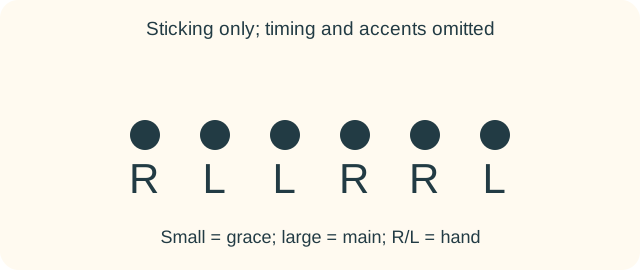
Expanded roll cards show each individual stroke. A same-hand double counts as two strokes, followed by the phrase’s final single. The six-stroke pattern also has a particular hand order that a count alone cannot identify.
Use the official notation after recognition
The PAS chart supplies rhythmic notation, grouping and accents that a hand-letter card cannot replace. Try rolls/diddles, then grace-stroke patterns, then the five reading-context questions. A worksheet can separate hand-sequence recognition from discussion of what the card omits.
Put it into practice
Further reading: Percussive Arts Society: International Drum Rudiments · PAS: official 40-rudiment notation chart
QUESTIONS & ANSWERS
Drum rudiment identification quiz: the full question sheet
Recognize original sticking cards, count roll strokes and distinguish flam and drag grace groups. The 30-question bank gives explained answers; a mixed round draws ten.
By Quizpen · Updated
Browse the full question bank30 questions & answers
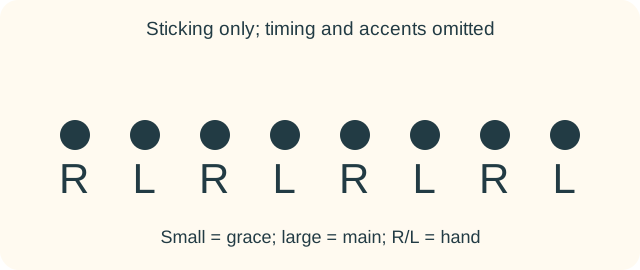
Which basic roll uses the shown continuously alternating single-hand strokes?
 Open diagram at full size ↗
Image source & credit
Original diagram by Quizpen Source ↗ · Quizpen original artwork. Resized for display.
Reveal answer
Single Stroke Roll. The hands alternate one stroke at a time. The card isolates sticking; the source notation supplies the rhythmic presentation.
Sources for this answer
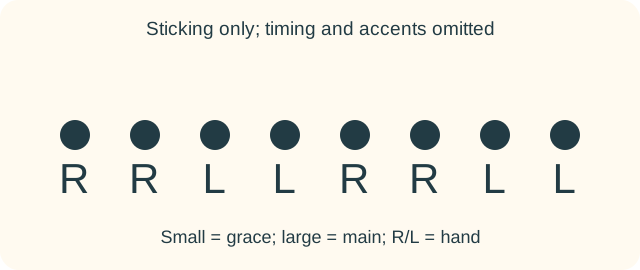
Which basic roll matches these repeating pairs of strokes by the same hand?
 Open diagram at full size ↗
Image source & credit
Original diagram by Quizpen Source ↗ · Quizpen original artwork. Resized for display.
Reveal answer
Double Stroke Open Roll. The displayed pattern repeats two right strokes and two left strokes. This is the double-stroke hand pattern rather than alternating singles.
Sources for this answer
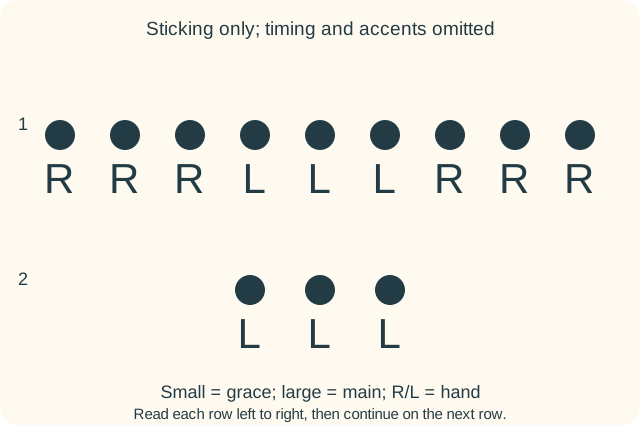
Which roll is associated with these repeating groups of three strokes per hand?
 Open diagram at full size ↗
Image source & credit
Original diagram by Quizpen Source ↗ · Quizpen original artwork. Resized for display.
Reveal answer
Triple Stroke Roll. Three strokes by one hand alternate with three by the other. The card does not specify the source’s complete rhythmic notation.
Sources for this answer
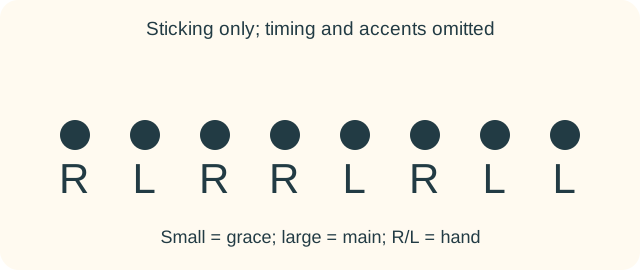
Which diddle rudiment matches R L R R followed by L R L L?
 Open diagram at full size ↗
Image source & credit
Original diagram by Quizpen Source ↗ · Quizpen original artwork. Resized for display.
Reveal answer
Single Paradiddle. Each leading-hand phrase contains two alternating singles followed by a same-hand double. The second phrase reverses the lead.
Sources for this answer
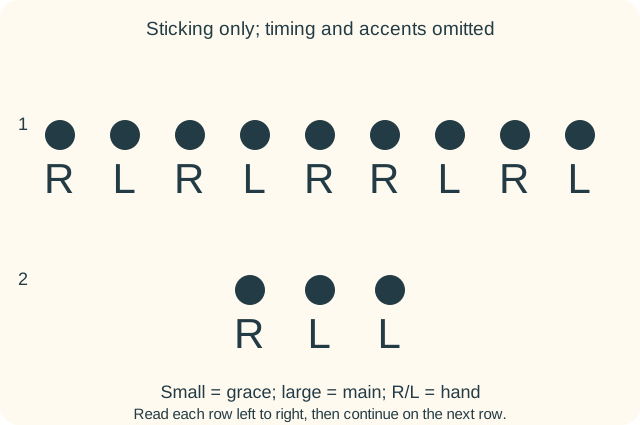
Which diddle rudiment has a right-leading phrase R L R L R R?
 Open diagram at full size ↗
Image source & credit
Original diagram by Quizpen Source ↗ · Quizpen original artwork. Resized for display.
Reveal answer
Double Paradiddle. Four alternating singles lead into the same-hand double. Its mirrored phrase leads with the other hand.
Sources for this answer
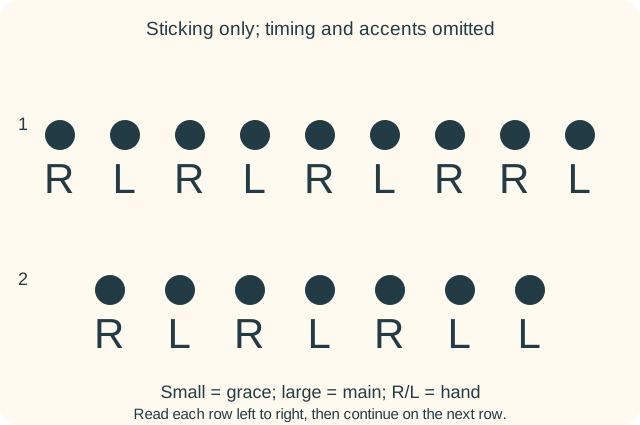
Which diddle rudiment has a right-leading phrase R L R L R L R R?
 Open diagram at full size ↗
Image source & credit
Original diagram by Quizpen Source ↗ · Quizpen original artwork. Resized for display.
Reveal answer
Triple Paradiddle. Six alternating singles precede the double in the leading-hand phrase. Count the singles before the repeated hand, not merely the final two strokes.
Sources for this answer
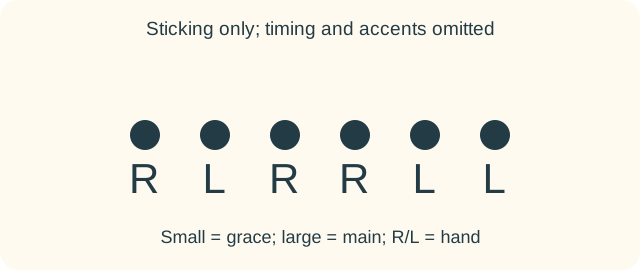
Which named diddle phrase is shown by R L R R L L?
 Open diagram at full size ↗
Image source & credit
Original diagram by Quizpen Source ↗ · Quizpen original artwork. Resized for display.
Reveal answer
Single Paradiddle-diddle. The phrase has two alternating singles followed by two same-hand doubles. Its timing and accent treatment still come from notation.
Sources for this answer
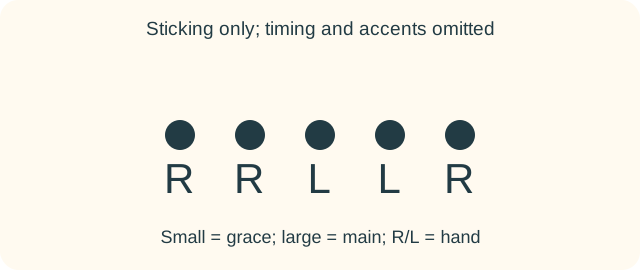
Which numbered double-stroke roll matches this expanded phrase: R R L L R?
 Open diagram at full size ↗
Image source & credit
Original diagram by Quizpen Source ↗ · Quizpen original artwork. Resized for display.
Reveal answer
Five Stroke Roll. The phrase contains 5 individual strokes: same-hand doubles followed by its final single. The source writes the roll with rhythmic notation; this expanded card makes its stroke count visible.
Sources for this answer
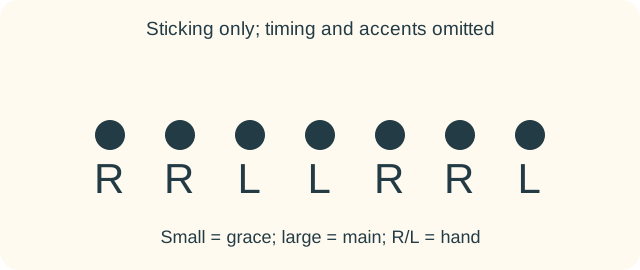
Which numbered double-stroke roll matches this expanded phrase: R R L L R R L?
 Open diagram at full size ↗
Image source & credit
Original diagram by Quizpen Source ↗ · Quizpen original artwork. Resized for display.
Reveal answer
Seven Stroke Roll. The phrase contains 7 individual strokes: same-hand doubles followed by its final single. The source writes the roll with rhythmic notation; this expanded card makes its stroke count visible.
Sources for this answer
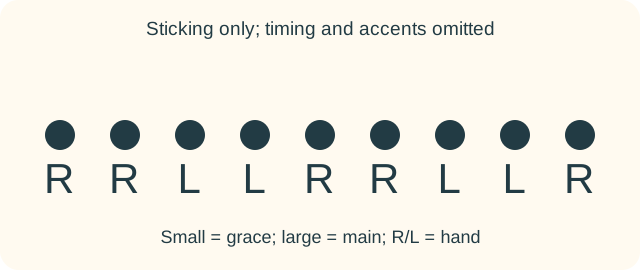
Which numbered double-stroke roll matches this expanded phrase: R R L L R R L L R?
 Open diagram at full size ↗
Image source & credit
Original diagram by Quizpen Source ↗ · Quizpen original artwork. Resized for display.
Reveal answer
Nine Stroke Roll. The phrase contains 9 individual strokes: same-hand doubles followed by its final single. The source writes the roll with rhythmic notation; this expanded card makes its stroke count visible.
Sources for this answer
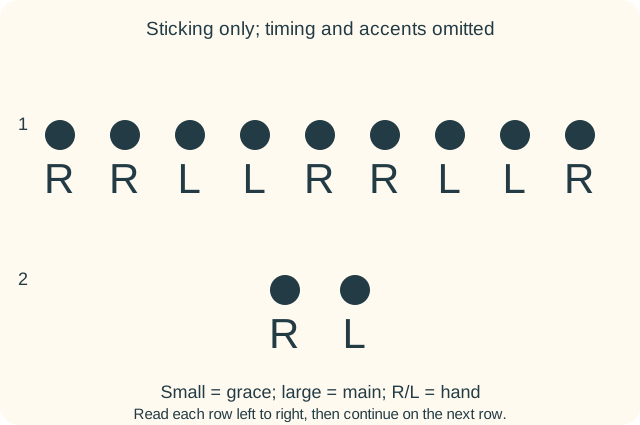
Which numbered double-stroke roll matches this expanded phrase: R R L L R R L L R R L?
 Open diagram at full size ↗
Image source & credit
Original diagram by Quizpen Source ↗ · Quizpen original artwork. Resized for display.
Reveal answer
Eleven Stroke Roll. The phrase contains 11 individual strokes: same-hand doubles followed by its final single. The source writes the roll with rhythmic notation; this expanded card makes its stroke count visible.
Sources for this answer
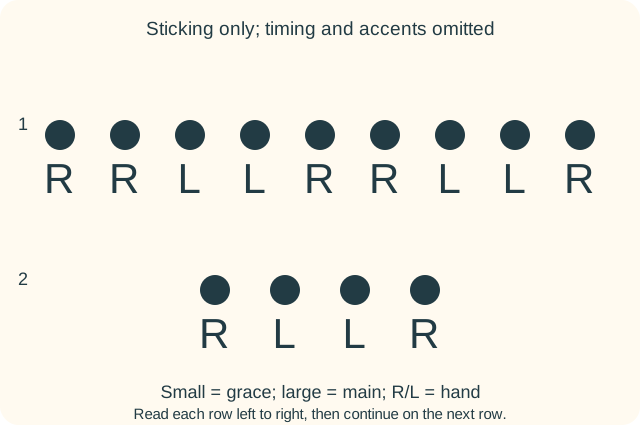
Which numbered double-stroke roll matches this expanded phrase: R R L L R R L L R R L L R?
 Open diagram at full size ↗
Image source & credit
Original diagram by Quizpen Source ↗ · Quizpen original artwork. Resized for display.
Reveal answer
Thirteen Stroke Roll. The phrase contains 13 individual strokes: same-hand doubles followed by its final single. The source writes the roll with rhythmic notation; this expanded card makes its stroke count visible.
Sources for this answer
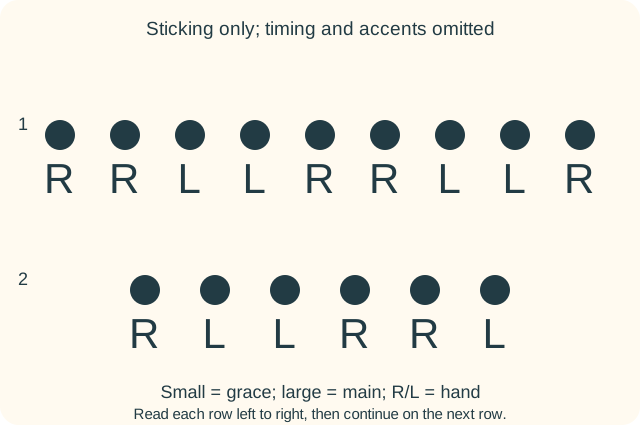
Which numbered double-stroke roll matches this expanded phrase: R R L L R R L L R R L L R R L?
 Open diagram at full size ↗
Image source & credit
Original diagram by Quizpen Source ↗ · Quizpen original artwork. Resized for display.
Reveal answer
Fifteen Stroke Roll. The phrase contains 15 individual strokes: same-hand doubles followed by its final single. The source writes the roll with rhythmic notation; this expanded card makes its stroke count visible.
Sources for this answer
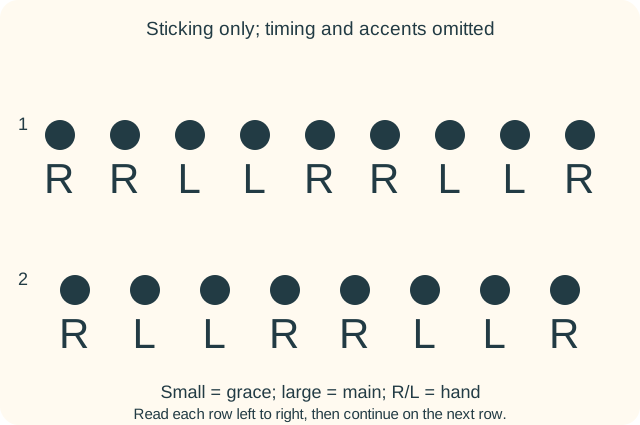
Which numbered double-stroke roll matches this expanded phrase: R R L L R R L L R R L L R R L L R?
 Open diagram at full size ↗
Image source & credit
Original diagram by Quizpen Source ↗ · Quizpen original artwork. Resized for display.
Reveal answer
Seventeen Stroke Roll. The phrase contains 17 individual strokes: same-hand doubles followed by its final single. The source writes the roll with rhythmic notation; this expanded card makes its stroke count visible.
Sources for this answer
Which numbered roll has the displayed six-stroke sticking R L L R R L?
 Open diagram at full size ↗
Image source & credit
Original diagram by Quizpen Source ↗ · Quizpen original artwork. Resized for display.
Reveal answer
Six Stroke Roll. The six-stroke phrase begins and ends with singles around two doubles. Six letters alone are not full rhythmic notation; the hand order matters.
Sources for this answer
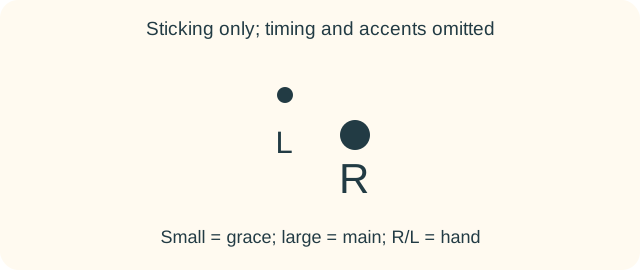
A single small opposite-hand stroke precedes a large main stroke. Which basic rudiment is being represented?
 Open diagram at full size ↗
Image source & credit
Original diagram by Quizpen Source ↗ · Quizpen original artwork. Resized for display.
Reveal answer
Flam. A flam has one grace stroke preceding its main stroke, using opposite hands. The small and large marks distinguish their roles; they are not two equal simultaneous hits.
Sources for this answer
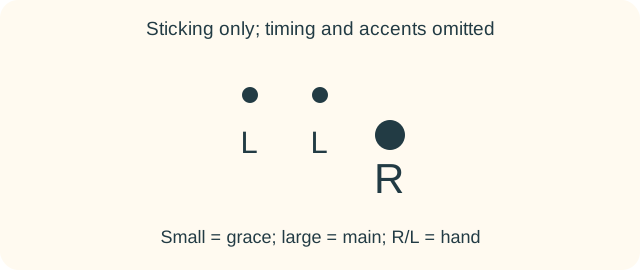
Two small same-hand strokes precede an opposite-hand main stroke. Which basic rudiment does that show?
 Open diagram at full size ↗
Image source & credit
Original diagram by Quizpen Source ↗ · Quizpen original artwork. Resized for display.
Reveal answer
Drag. The drag includes a two-stroke grace group before the main stroke. The shown sticking begins with two left grace strokes and a right main stroke.
Sources for this answer
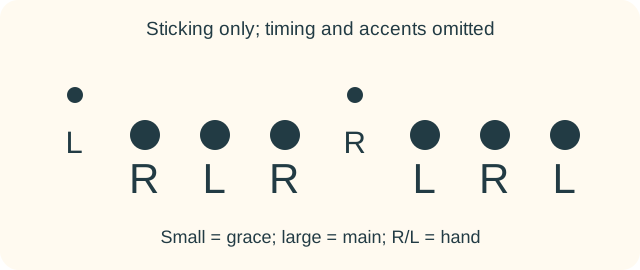
This card shows a flam followed by two alternating main strokes, then a mirrored phrase. Which rudiment matches?
 Open diagram at full size ↗
Image source & credit
Original diagram by Quizpen Source ↗ · Quizpen original artwork. Resized for display.
Reveal answer
Flam Accent. The main strokes alternate in three-stroke phrases, with the flam at the beginning. The card omits the rhythmic values and accents of the full score.
Sources for this answer
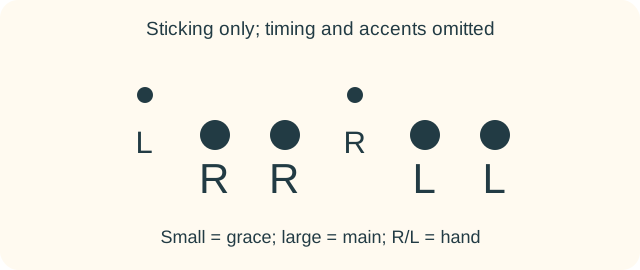
This card pairs a right-hand flam/main stroke with another right stroke, then mirrors that on the left. Which rudiment matches?
 Open diagram at full size ↗
Image source & credit
Original diagram by Quizpen Source ↗ · Quizpen original artwork. Resized for display.
Reveal answer
Flam Tap. Flam Tap combines a flam and a same-hand tap before changing lead. Distinguish the small grace stroke from the main-hand letters.
Sources for this answer
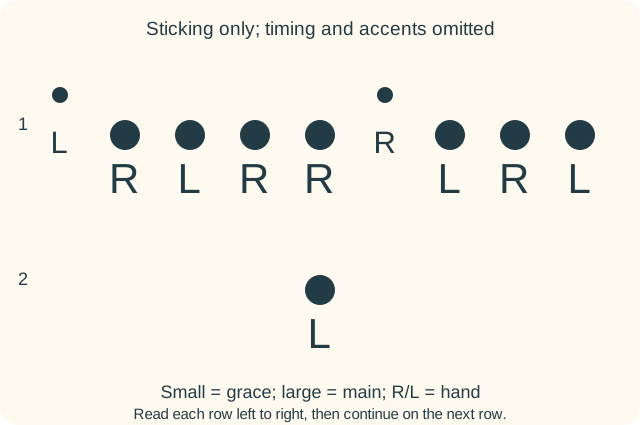
Which rudiment adds a flam to the start of each shown paradiddle phrase?
 Open diagram at full size ↗
Image source & credit
Original diagram by Quizpen Source ↗ · Quizpen original artwork. Resized for display.
Reveal answer
Flam Paradiddle. The main-hand sequence follows the paradiddle pattern, while the small opposite-hand note precedes its leading main stroke.
Sources for this answer
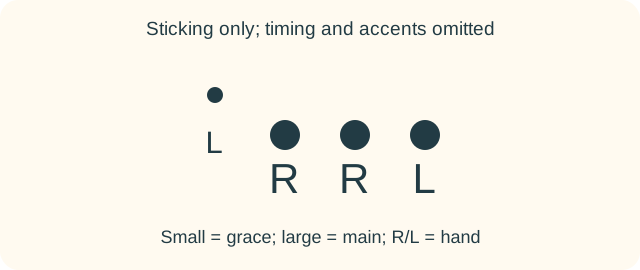
In the shown Swiss Army Triplet phrase lR R L, which main hand is repeated before the final L?
 Open diagram at full size ↗
Image source & credit
Original diagram by Quizpen Source ↗ · Quizpen original artwork. Resized for display.
Reveal answer
R. The small l is the grace stroke. Reading only the large main strokes gives R R L; the first two main strokes use the right hand.
Sources for this answer
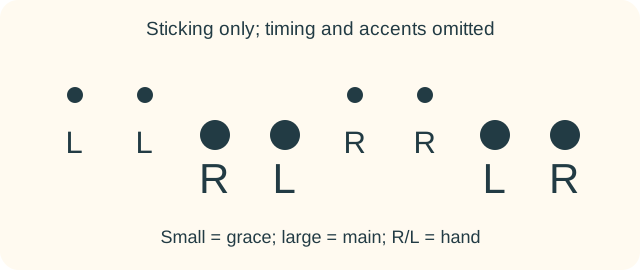
Which drag-family rudiment matches a drag plus one alternating main tap in each mirrored phrase?
 Open diagram at full size ↗
Image source & credit
Original diagram by Quizpen Source ↗ · Quizpen original artwork. Resized for display.
Reveal answer
Single Drag Tap. Each leading phrase has one two-stroke grace group before its first main stroke, followed by the opposite main hand.
Sources for this answer
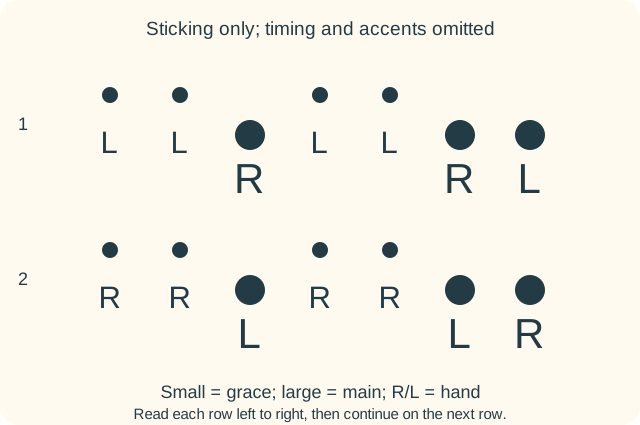
Which drag-family rudiment shows two drag groups before the final alternating main tap in each phrase?
 Open diagram at full size ↗
Image source & credit
Original diagram by Quizpen Source ↗ · Quizpen original artwork. Resized for display.
Reveal answer
Double Drag Tap. Two separate grace groups precede the concluding main tap in the leading phrase. Count the grace groups, not just the large letters.
Sources for this answer
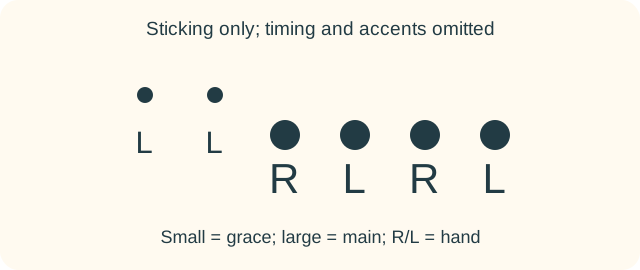
Which card-reading description fits the displayed beginning of a Single Ratamacue phrase?
 Open diagram at full size ↗
Image source & credit
Original diagram by Quizpen Source ↗ · Quizpen original artwork. Resized for display.
Reveal answer
Two left grace strokes, then main strokes R L R L. The two small left strokes belong before the first main R. The full rudiment’s rhythmic grouping and final accent are given in the source score.
Sources for this answer
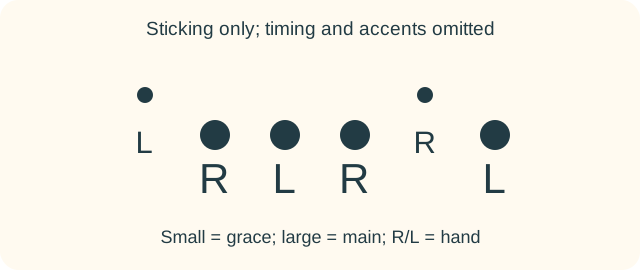
In this Pataflafla phrase, count the main strokes that have a preceding small grace stroke.
 Open diagram at full size ↗
Image source & credit
Original diagram by Quizpen Source ↗ · Quizpen original artwork. Resized for display.
Reveal answer
2. The first and fourth main strokes have small opposite-hand grace strokes. The card preserves that hand relationship while omitting timing and accent notation.
Sources for this answer
Which set names the four top-level rudiment families on the PAS chart?
Reveal answer
Roll, diddle, flam and drag. These are the chart’s four organizational families. Instrument names and pitch concepts are different classifications.
Sources for this answer
In these sticking cards, what do R and L identify?
Reveal answer
The hand used for each stroke. The letters mark right and left hand. Timing, dynamic level and instrument choice require separate information.
Sources for this answer
What distinguishes a basic flam grace group from a basic drag grace group?
Reveal answer
One grace stroke versus two. The source shows one grace stroke before the flam’s main stroke and two before the drag’s. Both still need their full performance context.
Sources for this answer
Does a sticking-only card specify every rhythmic value and accent of the official score?
Reveal answer
No; full notation supplies additional information. The hand sequence is one layer of information. The source notation separately shows duration, grouping, grace-note form and accents.
Sources for this answer
A player swaps every R and L in the displayed Single Paradiddle pattern while preserving the relationships. What changed?
Reveal answer
The leading hand. Mirroring the hands changes the lead while keeping the single-paradiddle relationships. The official chart shows both leads.
Sources for this answer
Answer key
- Single Stroke Roll. The hands alternate one stroke at a time. The card isolates sticking; the source notation supplies the rhythmic presentation.
- Double Stroke Open Roll. The displayed pattern repeats two right strokes and two left strokes. This is the double-stroke hand pattern rather than alternating singles.
- Triple Stroke Roll. Three strokes by one hand alternate with three by the other. The card does not specify the source’s complete rhythmic notation.
- Single Paradiddle. Each leading-hand phrase contains two alternating singles followed by a same-hand double. The second phrase reverses the lead.
- Double Paradiddle. Four alternating singles lead into the same-hand double. Its mirrored phrase leads with the other hand.
- Triple Paradiddle. Six alternating singles precede the double in the leading-hand phrase. Count the singles before the repeated hand, not merely the final two strokes.
- Single Paradiddle-diddle. The phrase has two alternating singles followed by two same-hand doubles. Its timing and accent treatment still come from notation.
- Five Stroke Roll. The phrase contains 5 individual strokes: same-hand doubles followed by its final single. The source writes the roll with rhythmic notation; this expanded card makes its stroke count visible.
- Seven Stroke Roll. The phrase contains 7 individual strokes: same-hand doubles followed by its final single. The source writes the roll with rhythmic notation; this expanded card makes its stroke count visible.
- Nine Stroke Roll. The phrase contains 9 individual strokes: same-hand doubles followed by its final single. The source writes the roll with rhythmic notation; this expanded card makes its stroke count visible.
- Eleven Stroke Roll. The phrase contains 11 individual strokes: same-hand doubles followed by its final single. The source writes the roll with rhythmic notation; this expanded card makes its stroke count visible.
- Thirteen Stroke Roll. The phrase contains 13 individual strokes: same-hand doubles followed by its final single. The source writes the roll with rhythmic notation; this expanded card makes its stroke count visible.
- Fifteen Stroke Roll. The phrase contains 15 individual strokes: same-hand doubles followed by its final single. The source writes the roll with rhythmic notation; this expanded card makes its stroke count visible.
- Seventeen Stroke Roll. The phrase contains 17 individual strokes: same-hand doubles followed by its final single. The source writes the roll with rhythmic notation; this expanded card makes its stroke count visible.
- Six Stroke Roll. The six-stroke phrase begins and ends with singles around two doubles. Six letters alone are not full rhythmic notation; the hand order matters.
- Flam. A flam has one grace stroke preceding its main stroke, using opposite hands. The small and large marks distinguish their roles; they are not two equal simultaneous hits.
- Drag. The drag includes a two-stroke grace group before the main stroke. The shown sticking begins with two left grace strokes and a right main stroke.
- Flam Accent. The main strokes alternate in three-stroke phrases, with the flam at the beginning. The card omits the rhythmic values and accents of the full score.
- Flam Tap. Flam Tap combines a flam and a same-hand tap before changing lead. Distinguish the small grace stroke from the main-hand letters.
- Flam Paradiddle. The main-hand sequence follows the paradiddle pattern, while the small opposite-hand note precedes its leading main stroke.
- R. The small l is the grace stroke. Reading only the large main strokes gives R R L; the first two main strokes use the right hand.
- Single Drag Tap. Each leading phrase has one two-stroke grace group before its first main stroke, followed by the opposite main hand.
- Double Drag Tap. Two separate grace groups precede the concluding main tap in the leading phrase. Count the grace groups, not just the large letters.
- Two left grace strokes, then main strokes R L R L. The two small left strokes belong before the first main R. The full rudiment’s rhythmic grouping and final accent are given in the source score.
- 2. The first and fourth main strokes have small opposite-hand grace strokes. The card preserves that hand relationship while omitting timing and accent notation.
- Roll, diddle, flam and drag. These are the chart’s four organizational families. Instrument names and pitch concepts are different classifications.
- The hand used for each stroke. The letters mark right and left hand. Timing, dynamic level and instrument choice require separate information.
- One grace stroke versus two. The source shows one grace stroke before the flam’s main stroke and two before the drag’s. Both still need their full performance context.
- No; full notation supplies additional information. The hand sequence is one layer of information. The source notation separately shows duration, grouping, grace-note form and accents.
- The leading hand. Mirroring the hands changes the lead while keeping the single-paradiddle relationships. The official chart shows both leads.