
Language & music / 10-question mixed rounds
Dewey Decimal shelf-order quiz
Practice Dewey Decimal shelf order with 30 original questions, decimal comparisons, book-spine sequences, author ties and local-policy explanations.
Mixed rounds: about 3–5 minutes · No timer
10 random questions per mixed round · 30 questions in the full bank below
Published by Quizpen · Explanations include linked supporting reading. See our source-checking process and review limits.
PRACTICE BY SKILL
Choose a focused round
Practice one part of this topic with every question in that skill. Focused practice is separate from ten-question mixed rounds.
Getting your round ready…
BEHIND THE ROUND
A little more about this quiz
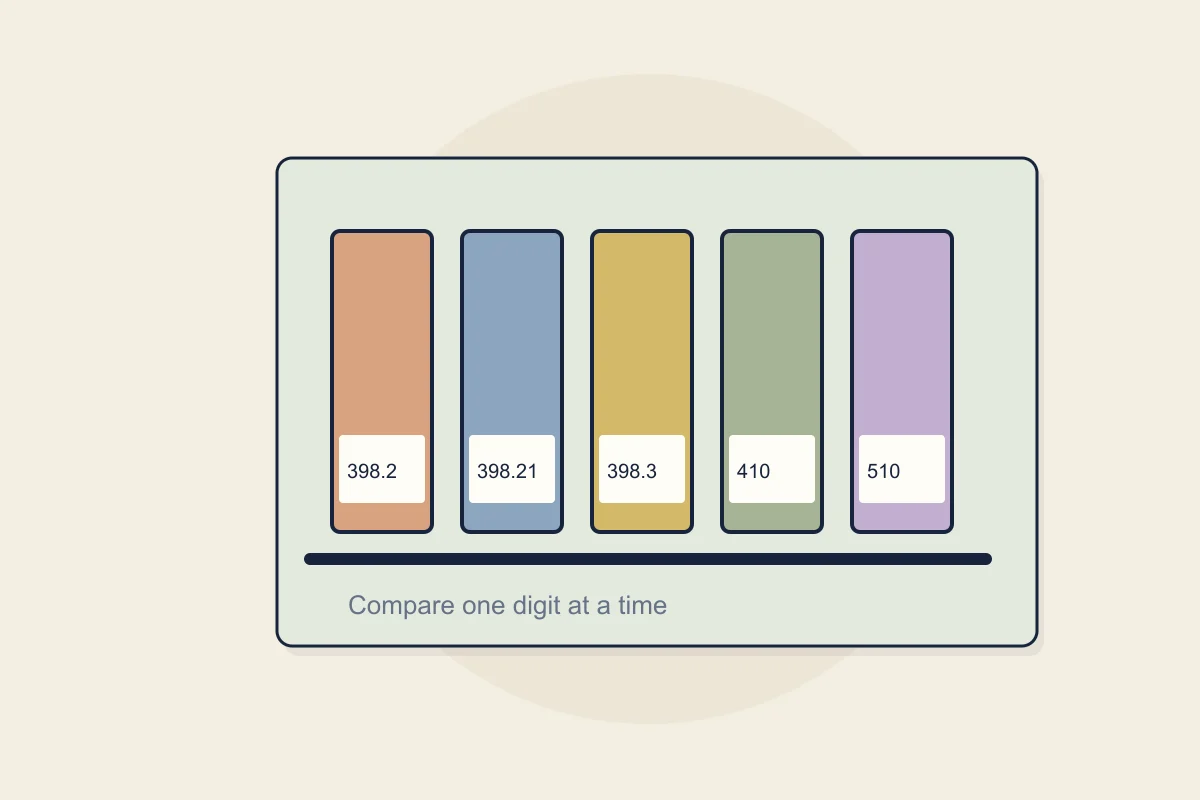
The numeric part of a Dewey label is compared by place value. A long decimal is not automatically larger than a short one. Once numeric values tie, a stated author or title rule can become relevant.
These original labels practice ordering without reproducing a subject schedule. The policy questions also show where a simple exercise stops and a real library’s complete guide is needed.
LEARN THE PATTERN
How to practice Dewey Decimal shelf order
Choose decimal order, complete short book-spine sequences and apply stated author/title ties. There are 30 explained questions, with ten in a mixed round.
Dewey Decimal shelf-order reference
Synthetic labels in a fictional collection. Compare numeric values first, then use only the author/title rule stated in the question. Real libraries may use different collection, Cutter and other filing policies.
| Step | What to compare | Limit |
|---|---|---|
| Numeric part | Three-digit value, then decimal places | Character count is not numeric order |
| Numeric tie | The next field explicitly supplied | Do not invent an author rule |
| Author tie | The stated title rule, if any | Article and punctuation handling can vary |
| Size or collection prefix | Catalog location and library policy | A prefix is not automatically a shared shelf rule |
| Cutter / work / copy fields | The complete local filing instructions | Beyond simple three-letter author labels |
Read each question’s stated scope and key before answering.
Reference sources: Alaska State Library: K–12 handbook, section S-4 (2000) · University of Illinois: Dewey call-number components
Check what you remember
Look away from the table. Try each question, then open it to check your answer.
Is .109 greater than .12 because it has more digits?Show answer
No. Compare decimal values: .109 is smaller.
Can a simplified rule locate every real library item?Show answer
No. Collection locations and additional call-number fields may require that library’s complete policy.
Find the first differing place
Compare the three-digit numeric part before moving to the tenths, hundredths and later decimal places. If the early places decide the order, later digits cannot reverse it.
Use a tie rule only after a tie
This bank states its author and title conventions when they are used. A surname abbreviation, title article or trailing-zero display should not invite an unstated assumption about a real catalog.
Keep collection policy visible
Size marks, collection locations, Cutter numbers and copy information can add requirements. Use the four policy questions to practice recognizing missing information. For a classroom round, print a numeric subset first and then add the tie questions.
Put it into practice
Further reading: Alaska State Library: K–12 handbook, section S-4 (2000) · University of Illinois: Dewey call-number components
QUESTIONS & ANSWERS
Dewey Decimal shelf-order quiz: the full question sheet
Choose decimal order, complete short book-spine sequences and apply stated author/title ties. There are 30 explained questions, with ten in a mixed round.
By Quizpen · Updated
Browse the full question bank30 questions & answers
In one practice collection, which invented numeric label comes earlier: 418.7 or 419.02?
Reveal answer
418.7. 418.7 is the smaller numeric value. Compare the three-digit part first, then decimal places from left to right; printed length is not the sorting rule.
Sources for this answer
In one practice collection, which invented numeric label comes earlier: 325.07 or 325.1?
Reveal answer
325.07. 325.07 is the smaller numeric value. Compare the three-digit part first, then decimal places from left to right; printed length is not the sorting rule.
Sources for this answer
In one practice collection, which invented numeric label comes earlier: 712.035 or 712.04?
Reveal answer
712.035. 712.035 is the smaller numeric value. Compare the three-digit part first, then decimal places from left to right; printed length is not the sorting rule.
Sources for this answer
In one practice collection, which invented numeric label comes earlier: 581.203 or 581.209?
Reveal answer
581.203. 581.203 is the smaller numeric value. Compare the three-digit part first, then decimal places from left to right; printed length is not the sorting rule.
Sources for this answer
In one practice collection, which invented numeric label comes earlier: 684.3 or 684.31?
Reveal answer
684.3. 684.3 is the smaller numeric value. Compare the three-digit part first, then decimal places from left to right; printed length is not the sorting rule.
Sources for this answer
In one practice collection, which invented numeric label comes earlier: 681.009 or 681.09?
Reveal answer
681.009. 681.009 is the smaller numeric value. Compare the three-digit part first, then decimal places from left to right; printed length is not the sorting rule.
Sources for this answer
In one practice collection, which invented numeric label comes earlier: 227.1998 or 227.2?
Reveal answer
227.1998. 227.1998 is the smaller numeric value. Compare the three-digit part first, then decimal places from left to right; printed length is not the sorting rule.
Sources for this answer
In one practice collection, which invented numeric label comes earlier: 573.141 or 573.149?
Reveal answer
573.141. 573.141 is the smaller numeric value. Compare the three-digit part first, then decimal places from left to right; printed length is not the sorting rule.
Sources for this answer
Under this exercise’s numeric-value rule, how do 421.5 and 421.50 compare?
Reveal answer
Their numeric values are equal. A trailing zero does not change a decimal’s numeric value. If another filing field matters, use the next rule explicitly supplied for that exercise.
Sources for this answer
Which method correctly compares 438.109 and 438.12?
Reveal answer
Compare decimal places from left to right. The first different place decides: at the hundredths place, 0 is less than 2. Therefore 438.109 precedes 438.12.
Sources for this answer
Choose the earlier-to-later order for these invented spines: 712.6, 712.04, 712.035, 712.12.
712.6 · 712.12 · 712.04 · 712.035
Reveal answer
712.035 → 712.04 → 712.12 → 712.6. Compare numeric values, not character counts. The correct sequence increases at each step; checking neighboring pairs is a useful way to catch a reversal.
Sources for this answer
Choose the earlier-to-later order for these invented spines: 439.01, 438.15, 438.1, 438.2.
439.01 · 438.2 · 438.15 · 438.1
Reveal answer
438.1 → 438.15 → 438.2 → 439.01. Compare numeric values, not character counts. The correct sequence increases at each step; checking neighboring pairs is a useful way to catch a reversal.
Sources for this answer
Choose the earlier-to-later order for these invented spines: 621.4, 621.31, 621.304, 621.32.
621.4 · 621.32 · 621.31 · 621.304
Reveal answer
621.304 → 621.31 → 621.32 → 621.4. Compare numeric values, not character counts. The correct sequence increases at each step; checking neighboring pairs is a useful way to catch a reversal.
Sources for this answer
Choose the earlier-to-later order for these invented spines: 101, 100, 099.8, 100.01.
101 · 100.01 · 100 · 099.8
Reveal answer
099.8 → 100 → 100.01 → 101. Compare numeric values, not character counts. The correct sequence increases at each step; checking neighboring pairs is a useful way to catch a reversal.
Sources for this answer
Choose the earlier-to-later order for these invented spines: 584.1, 584.01, 584.009, 584.099.
584.1 · 584.099 · 584.01 · 584.009
Reveal answer
584.009 → 584.01 → 584.099 → 584.1. Compare numeric values, not character counts. The correct sequence increases at each step; checking neighboring pairs is a useful way to catch a reversal.
Sources for this answer
Choose the earlier-to-later order for these invented spines: 228, 227.2, 227.1998, 227.21.
228 · 227.21 · 227.2 · 227.1998
Reveal answer
227.1998 → 227.2 → 227.21 → 228. Compare numeric values, not character counts. The correct sequence increases at each step; checking neighboring pairs is a useful way to catch a reversal.
Sources for this answer
An ascending practice shelf has neighboring labels 438.1 and 438.2. Where does 438.15 belong?
Reveal answer
Between 438.1 and 438.2. The value 438.15 is greater than 438.1 and less than 438.2. Check both neighbors before inserting a book.
Sources for this answer
An ascending practice shelf has neighboring labels 621.31 and 621.32. Where does 621.315 belong?
Reveal answer
Between 621.31 and 621.32. The value 621.315 is greater than 621.31 and less than 621.32. Check both neighbors before inserting a book.
Sources for this answer
An ascending practice shelf has neighboring labels 584.009 and 584.01. Where does 584.0095 belong?
Reveal answer
Between 584.009 and 584.01. The value 584.0095 is greater than 584.009 and less than 584.01. Check both neighbors before inserting a book.
Sources for this answer
An ascending practice shelf has neighboring labels 712.12 and 712.13. Where does 712.125 belong?
Reveal answer
Between 712.12 and 712.13. The value 712.125 is greater than 712.12 and less than 712.13. Check both neighbors before inserting a book.
Sources for this answer
All three invented spines show 320.4. This shelf next alphabetizes their displayed author labels. Which comes first: SIN, BAK or ADA?
Reveal answer
ADA. The numeric field ties, so use the explicitly supplied author-label rule. ADA precedes labels beginning B and S.
Sources for this answer
All numbers tie. Under the stated author-label rule, which order is correct for CAT, CHA and CAR?
CHA · CAT · CAR
Reveal answer
CAR → CAT → CHA. Compare beyond the first letter. CAR precedes CAT at the third letter, and both CA labels precede CH.
Sources for this answer
This practice shelf compares the numeric label first. Which comes earlier: 418.7 ZED or 419.02 ADA?
Reveal answer
418.7 ZED. The numeric fields differ, so they decide before the author labels. A smaller numeric class comes earlier within the same stated collection.
Sources for this answer
Two invented books have the same numeric label and full author. This exercise next alphabetizes titles. Which title comes first?
Reveal answer
Small Gardens. Under the stated title rule, S precedes W. The title tie-break is used only after the preceding fields match.
Sources for this answer
A classroom policy explicitly ignores initial A, An and The when comparing titles. With number and author tied, which comes first: The Amber Kite or Blue Windows?
Reveal answer
The Amber Kite. For this explicitly stated policy, compare Amber with Blue. Do not assume this article-handling rule applies in every library.
Sources for this answer
Compare the numbers by value, then author labels alphabetically. Which comes first: 421.50 ADA or 421.5 ZED?
Reveal answer
421.50 ADA. The numeric values tie. Under the exercise’s declared next rule, ADA comes before ZED. This does not establish a universal catalog-normalization policy.
Sources for this answer
Two labels have the same number and the same shortened author letters, but refer to different full authors. No next filing rule is supplied. Can this exercise choose one unique order?
Reveal answer
No; check the complete labels and local filing rule. A shortened display may omit information needed to distinguish items. Real call numbers can include additional fields, so an unstated rule must not be guessed.
Sources for this answer
A library guide identifies Q as a size designation. You have Q 855.1 but no catalog location or oversize policy. Can a basic decimal comparison locate its physical shelf?
Reveal answer
No; check the location and that library’s policy. A size designation is separate from the numeric class. Collection arrangement and location information are needed before asserting a physical shelf.
Sources for this answer
A real label contains a Dewey number, an alphanumeric Cutter, and work/copy information. The exercise only defines simple author-letter ties. What should you do?
Reveal answer
Consult that library’s complete filing guide. Cutter and work/copy details can carry information beyond this simplified exercise. The library’s full rules are needed for those fields.
Sources for this answer
Two catalog records show different collection locations, including a fiction prefix. No policy explains whether the collections are interfiled. What is justified?
Reveal answer
Check each location and its filing policy. A location or collection distinction can change where an item belongs. The supplied information does not establish a universal cross-collection sequence.
Sources for this answer
Answer key
- 418.7. 418.7 is the smaller numeric value. Compare the three-digit part first, then decimal places from left to right; printed length is not the sorting rule.
- 325.07. 325.07 is the smaller numeric value. Compare the three-digit part first, then decimal places from left to right; printed length is not the sorting rule.
- 712.035. 712.035 is the smaller numeric value. Compare the three-digit part first, then decimal places from left to right; printed length is not the sorting rule.
- 581.203. 581.203 is the smaller numeric value. Compare the three-digit part first, then decimal places from left to right; printed length is not the sorting rule.
- 684.3. 684.3 is the smaller numeric value. Compare the three-digit part first, then decimal places from left to right; printed length is not the sorting rule.
- 681.009. 681.009 is the smaller numeric value. Compare the three-digit part first, then decimal places from left to right; printed length is not the sorting rule.
- 227.1998. 227.1998 is the smaller numeric value. Compare the three-digit part first, then decimal places from left to right; printed length is not the sorting rule.
- 573.141. 573.141 is the smaller numeric value. Compare the three-digit part first, then decimal places from left to right; printed length is not the sorting rule.
- Their numeric values are equal. A trailing zero does not change a decimal’s numeric value. If another filing field matters, use the next rule explicitly supplied for that exercise.
- Compare decimal places from left to right. The first different place decides: at the hundredths place, 0 is less than 2. Therefore 438.109 precedes 438.12.
- 712.035 → 712.04 → 712.12 → 712.6. Compare numeric values, not character counts. The correct sequence increases at each step; checking neighboring pairs is a useful way to catch a reversal.
- 438.1 → 438.15 → 438.2 → 439.01. Compare numeric values, not character counts. The correct sequence increases at each step; checking neighboring pairs is a useful way to catch a reversal.
- 621.304 → 621.31 → 621.32 → 621.4. Compare numeric values, not character counts. The correct sequence increases at each step; checking neighboring pairs is a useful way to catch a reversal.
- 099.8 → 100 → 100.01 → 101. Compare numeric values, not character counts. The correct sequence increases at each step; checking neighboring pairs is a useful way to catch a reversal.
- 584.009 → 584.01 → 584.099 → 584.1. Compare numeric values, not character counts. The correct sequence increases at each step; checking neighboring pairs is a useful way to catch a reversal.
- 227.1998 → 227.2 → 227.21 → 228. Compare numeric values, not character counts. The correct sequence increases at each step; checking neighboring pairs is a useful way to catch a reversal.
- Between 438.1 and 438.2. The value 438.15 is greater than 438.1 and less than 438.2. Check both neighbors before inserting a book.
- Between 621.31 and 621.32. The value 621.315 is greater than 621.31 and less than 621.32. Check both neighbors before inserting a book.
- Between 584.009 and 584.01. The value 584.0095 is greater than 584.009 and less than 584.01. Check both neighbors before inserting a book.
- Between 712.12 and 712.13. The value 712.125 is greater than 712.12 and less than 712.13. Check both neighbors before inserting a book.
- ADA. The numeric field ties, so use the explicitly supplied author-label rule. ADA precedes labels beginning B and S.
- CAR → CAT → CHA. Compare beyond the first letter. CAR precedes CAT at the third letter, and both CA labels precede CH.
- 418.7 ZED. The numeric fields differ, so they decide before the author labels. A smaller numeric class comes earlier within the same stated collection.
- Small Gardens. Under the stated title rule, S precedes W. The title tie-break is used only after the preceding fields match.
- The Amber Kite. For this explicitly stated policy, compare Amber with Blue. Do not assume this article-handling rule applies in every library.
- 421.50 ADA. The numeric values tie. Under the exercise’s declared next rule, ADA comes before ZED. This does not establish a universal catalog-normalization policy.
- No; check the complete labels and local filing rule. A shortened display may omit information needed to distinguish items. Real call numbers can include additional fields, so an unstated rule must not be guessed.
- No; check the location and that library’s policy. A size designation is separate from the numeric class. Collection arrangement and location information are needed before asserting a physical shelf.
- Consult that library’s complete filing guide. Cutter and work/copy details can carry information beyond this simplified exercise. The library’s full rules are needed for those fields.
- Check each location and its filing policy. A location or collection distinction can change where an item belongs. The supplied information does not establish a universal cross-collection sequence.